
The Holiday Botox Rush Starts in October. So Do the Missed Calls.
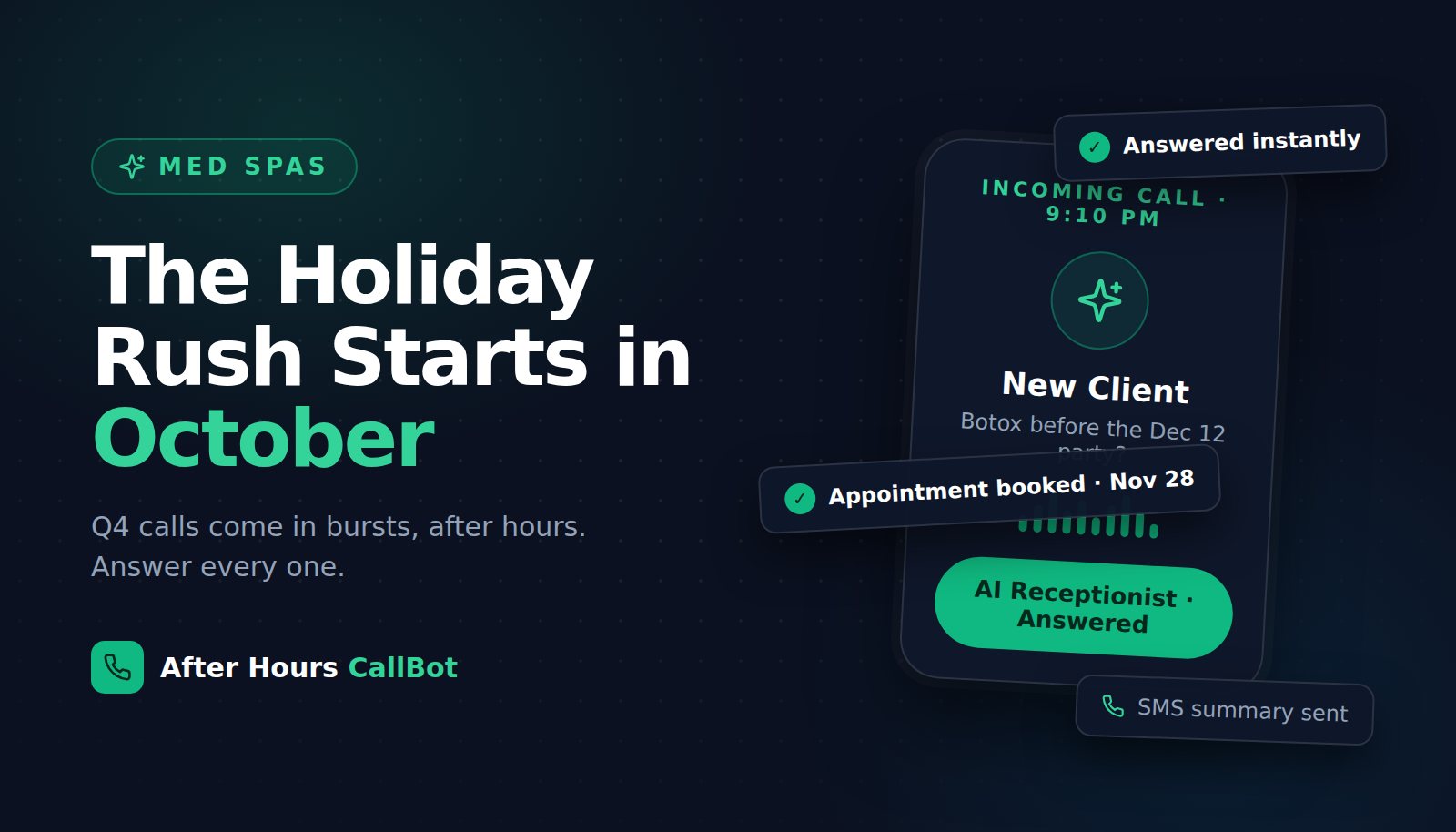
Every med spa owner knows Q4 is the year. Holiday parties, family photos, the end-of-year "I deserve this" — the American Med Spa Association's own planning guidance treats October through December as the peak of the annual cycle. What fewer owners plan for is that the rush arrives by phone, in a two-week window, at exactly the hours the front desk is in a treatment room or gone for the day. The patient who calls on October 28th to be ready for Thanksgiving is not a lead. She is a booked appointment, if anyone picks up.
Why Q4 booking is a phone problem, not a demand problem
- The timing is fixed and the patient knows it. Neurotoxins take roughly one to two weeks to reach full effect and filler settles over about two weeks. A patient who wants to look her best for a December 12th party is calling in the last week of November — and if she can't get through, she is calling the spa across town the same afternoon.
- The calls arrive in bursts. A promotional email goes out, an influencer posts, a gift-card offer runs, and the phone lights up for an hour. That hour is when one coordinator is checking in a patient and the other is in a consult.
- They arrive after hours. The patient thinking about holiday Botox is doing it on the couch at 9 PM, or in the car on a Saturday. Q4 evenings and weekends are when the front desk is closed and the phone is not.
- The value per call is high and repeatable. AmSpa's figure for average spend is $536 per patient visit. (ScaleHaven, citing AmSpa) A new patient booked in Q4 for a $12-a-unit neurotoxin treatment — a forehead is typically 20 units — is a patient who comes back in March.
AmSpa's seasonality guidance is explicit that Q4 planning cannot wait until the rush arrives. (American Med Spa Association) The same is true of the phone.
What the patient does when the call rings out
The most-cited figure on business voicemail, from a 2014 CRM Magazine analysis: 80% of callers sent to voicemail leave no message. (CRM Magazine) BrightLocal's 2026 survey of 1,227 US consumers found 75% choose a local business in under 30 minutes and 72% consider three or fewer. (BrightLocal) In a market where three med spas within ten minutes all offer the same neurotoxin at nearly the same price, the one that answers at 9 PM gets the appointment and the March follow-up.
When your coordinator calls back the next morning, Hiya's 2026 State of the Call report found 86% of calls from unknown numbers go unanswered. (Hiya) Harvard Business Review's audit of 2,241 companies found the average lead response was 42 hours, with 23% never responding. (Harvard Business Review, 2011) Forty-two hours in the last week of November is the difference between a booked appointment and a patient who is already dosed somewhere else.
The voicemail behaviour is covered in Why Customers Don't Leave Voicemails Anymore, and the general med spa case in Med Spa Missed Calls.
What the November rush is worth, and what a missed week costs
| Measure | Figure | Source |
|---|---|---|
| Average spend per patient visit | $536 | ScaleHaven, citing AmSpa |
| Neurotoxin, typical forehead | ≈ 20 units at $12/unit = $240 | The pricing example we use across our med spa material; substitute your own |
| Body contouring consult that books | ≈ $1,500 | Internal figure from our med spa material |
The conservative version for the two peak weeks: six calls a week ring out during promotions, evenings and Saturdays, and only one in three would have booked. That is four visits at $536, or about $2,100 in two weeks — before the follow-up visits those patients would have booked in Q1, and before the one CoolSculpting consult in the mix that alone covers a year of call coverage. Those inputs are assumptions, not measurements:
Why hiring seasonal front-desk help doesn't fix it
A seasonal coordinator covers the hours you schedule her for, one call at a time. The Q4 problem is the opposite shape: bursts of simultaneous calls after a promotion, and calls at 9 PM and on Saturday when nobody is scheduled. You would be paying for a seat that is quiet most of the day and still missing the burst and the evening. What Q4 needs is something that answers every call at once, at any hour, and is trained well enough to book a consult and quote the unit price without a human on the line.
Four ways to cover the rush, ranked by whether the patient hears a voice
| Option | Patient gets an answer now? | Covers 9 PM and Saturday? | Handles a post-promo burst? | Typical monthly cost |
|---|---|---|---|---|
| Front desk as usual | When not in a room | No | No — one line | Existing payroll |
| Seasonal coordinator | During her shift | Only if scheduled | No — one more line | $3,200–$4,500/mo for the season |
| Online booking only | No voice | Yes, for patients who won't call | Yes | Platform fees; the callers are lost |
| AI phone receptionist | Yes, every call, first ring | Yes | Yes, unlimited simultaneous calls | Flat rate. After Hours CallBot: $199–$499/mo |
What an AI receptionist does on a Q4 med spa call
It answers on the first ring, trained on your spa: your menu and pricing, your providers, your holiday promotions, your consult policy, your pre-treatment instructions. On a call it can:
- Book the treatment or consult into real calendar availability during the call (Google Calendar, Calendly and TidyCal on every plan), including the two-week-out timing the patient needs for an event.
- Quote from your price list — per-unit neurotoxin, syringe pricing, package and membership rates — so the caller books instead of "calling back to check."
- Capture new-patient intake and send the forms, so the December 3rd appointment doesn't start with paperwork.
- Handle the promo burst. The tenth caller after the email goes out gets the same first-ring answer as the first.
- Route the calls that need a provider — a post-treatment concern, a reaction question — with an immediate warm transfer or SMS alert.
- Text the coordinator a summary after every call, with the full transcript in the dashboard.
Setup is under ten minutes: paste your website and menu, pick a voice, forward your line. It answers in English and Spanish; other languages by request.
Hear it take a call now: (321) 504-5467.
The arithmetic
Plans run $199, $299 and $499 a month, each with included call time and $0.12 a minute beyond it, with a 14-day free trial and no card required.
Against a $536 average visit, the Starter plan pays for itself the first time it books one 9 PM call in November. The med-spa-specific setup, including menu pricing, consult booking and intake, is on the med spa answering service page.
Find out what the November rush will cost you if the phone rings out. Run the numbers, then start a free 14-day trial now, in October, so it is trained and forwarded before the first promotion goes out. Count the consults that book while the desk is in a room.
Frequently asked questions
- When is the busiest season for a med spa?
- October through December, ahead of holiday parties and family photos. AmSpa's seasonality guidance treats Q4 as the annual peak and advises planning for it well in advance.
- How far ahead should a patient book holiday Botox or filler?
- Neurotoxins take roughly one to two weeks to reach full effect and filler settles over about two weeks, so patients need to book two to three weeks before an event. That concentrates calls into a narrow late-November window.
- What is a missed med spa call worth?
- AmSpa's average is $536 per patient visit. Even at a one-in-three booking rate, one missed call is worth about $180 in expected first-visit revenue, before follow-up visits.
- Can an AI receptionist quote treatment prices?
- Yes, from the price list you provide — per-unit, per-syringe, packages and memberships — so callers can book on the spot instead of waiting for a callback.
- What about a patient calling with a post-treatment concern?
- You define the triggers. A reaction or post-treatment question is warm-transferred to a provider immediately or sent as an SMS alert, while booking and pricing calls are handled without interrupting the room.