
Your Agency Sells Response Time. Your Own Phone Goes to Voicemail.
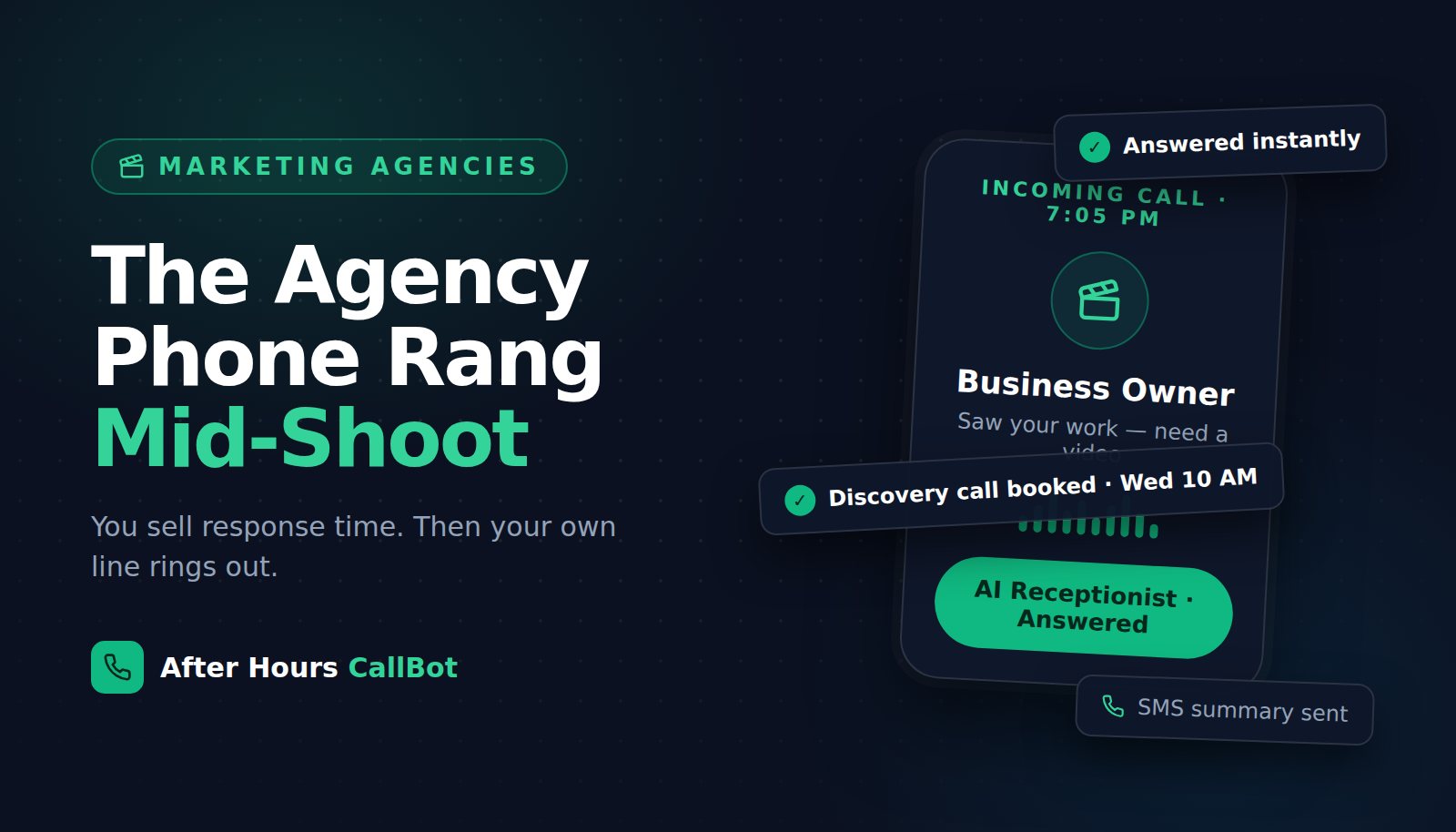
A video marketing agency's whole pitch to a client is speed and capture: we'll make the ad, the ad will make the phone ring, and the ring will turn into revenue. Then a business owner sees one of those ads on a Tuesday at 7 PM, likes it, looks up who made it, and calls the agency. The founder is on a shoot. The producer is in an edit. The phone goes to voicemail. The agency has just demonstrated, live, the exact failure it charges clients to prevent.
Agencies are B2B, and B2B is slow
The best-known B2B response study, from MIT and InsideSales, tracked more than 15,000 web-form leads across six companies. Contact within five minutes made a successful conversation 100 times more likely than at 30 minutes, and made the lead 21 times more likely to qualify. (MIT Lead Response Management Study) That was exactly the kind of lead an agency gets: a business owner filling in a form or dialling the number after seeing work they liked.
Harvard Business Review then audited 2,241 US companies and found only 37% responded to a lead within an hour, 23% never responded, and the average response time was 42 hours. (Harvard Business Review, 2011) Agencies are not exempt. They are structurally worse, because the people who can talk about a project are the same people who are on set or in post when the call comes in.
Why the agency phone is a strange phone
Most of the businesses on this blog get calls from consumers in a hurry. An agency's inbound is different in three ways that make voicemail more expensive, not less:
- The caller is a business owner calling on their own schedule, which is before 8, after 6, and on weekends, because that is when owners do the things that are not their business. Your hours are their busy hours.
- The caller is comparing three agencies and has already seen the work. BrightLocal's 2026 survey of 1,227 US consumers found 72% consider three or fewer businesses and 75% decide in under 30 minutes. (BrightLocal) Business owners are consumers too. The agency that picks up and books a discovery call is the one that gets to present.
- The ticket is large and the volume is small. Clutch's data across video production agencies puts the average agency project at $42,281, with most engagements under $10,000 and typical rates of $100–$149 an hour. (Clutch) An agency might get four real inbound calls a month. Each one is a five-figure decision. There is no volume to absorb a miss.
And then the callback fails on its own: the most-cited figure on business voicemail is that 80% of callers leave no message (CRM Magazine), and when you return the one who did from your cell, 86% of calls from unknown numbers go unanswered. (Hiya, 2026 State of the Call)
What one missed inquiry costs
| Measure | Figure | Source |
|---|---|---|
| Average video production agency project | $42,281 | Clutch |
| Typical smaller engagement | Under $10,000 | Clutch |
| Project value we use in our agency material | $10,000 (a brand film or a short ad campaign) | Internal assumption; substitute your own average |
The conservative version: two inbound inquiries a month ring out while the team is on a shoot. One in four would have become a client at a $10,000 first project. That is $5,000 a month in first-project revenue you never got to pitch, and agency clients tend to come back for the next campaign. Those inputs are assumptions, not measurements:
The second phone: your clients'
Here is the part that matters more than your own line. You make ads that make phones ring. What happens after the ring is your client's problem, and it is also the number your renewal depends on. If a plumber runs your ad, gets forty calls, and answers fourteen, they will tell you the ad didn't work. We go through that math in Paying for Calls Nobody Answers and, for the specific case of the ads you make, in Street Interview Ads vs. AI-Generated Ads.
Agencies that check call coverage before a campaign launches — and fix it — report better campaign results for the same spend, because the same ring now turns into a booked job. That is a service you can sell, and it is why After Hours CallBot has an affiliate program for agencies who recommend it to clients.
Four ways to cover your own line, ranked by whether the owner hears a voice
| Option | Caller gets an answer now? | Works during a shoot? | Books the discovery call? | Typical monthly cost |
|---|---|---|---|---|
| Founder's cell | Only if they can step off set | No | Sometimes | $0 plus a distracted director |
| Office manager or producer covers the phone | During office hours | Not when they're in the edit | Yes | Part of a salary; nothing at 7 PM |
| Web form only, no phone | No | — | Eventually, by email | $0, and the callers who prefer to talk go elsewhere |
| AI phone receptionist | Yes, every call, first ring | Yes | Yes, into your calendar | Flat rate. After Hours CallBot: $199–$499/mo |
What an AI receptionist does on an agency call
It answers on the first ring, trained on your agency: the work you do, your minimums, your process, your reel, the industries you serve. On a call it can:
- Qualify the inquiry the way your producer would: what are they trying to make, rough budget, timeline, who's the decision maker, have they worked with an agency before.
- Book the discovery call into real calendar availability (Google Calendar, Calendly and TidyCal on every plan) and send the confirmation with your reel link.
- Screen the vendors and recruiters so the founder's phone stops being a spam line.
- Escalate the big ones. A caller who says "$45,000 budget, need a proposal by Friday" triggers an immediate warm transfer or SMS alert.
- Text you the summary after each call, with the full transcript in the dashboard and a CRM push on Pro and Business.
Setup is under ten minutes: paste your website, pick a voice, forward the line. It answers in English and Spanish; other languages by request.
Hear it take a call now: (321) 504-5467.
The arithmetic
Plans run $199, $299 and $499 a month, each with included call time and $0.12 a minute beyond it, with a 14-day free trial and no card required.
Against a $10,000 first project, the Starter plan pays for itself for four years the first time it books one discovery call that would have gone to voicemail during a shoot. The agency-specific setup, including inquiry qualification and discovery-call booking, is on the video marketing agency answering service page.
Find out what your shoot days are costing. Run the numbers, then start a free 14-day trial and forward the line for two weeks. Count the discovery calls that book while you're on set.
Frequently asked questions
- How fast should an agency respond to an inbound lead?
- The MIT/InsideSales study found contact within five minutes made a conversation 100 times more likely than at 30 minutes. Most companies take far longer — HBR's audit found an average of 42 hours — which is why answering the call on the first ring is such an advantage.
- What is an average video agency project worth?
- Clutch's data across video production agencies puts the average project at about $42,000, with most engagements under $10,000. Either way, a single missed inquiry is a large decision for a business that gets a handful of calls a month.
- Can an AI receptionist qualify a project inquiry?
- Yes. You set the questions — project type, budget, timeline, decision maker — and it asks them naturally, then books a discovery call into your calendar and sends you the summary.
- Can I offer this to my clients?
- Yes. Agencies use it to make sure the calls their campaigns generate get answered, which improves the campaign's measured results. There is an affiliate program for agencies who refer clients.
- Will it screen sales calls and recruiters?
- Yes. Vendor pitches and recruiter calls are handled politely without reaching you; genuine project inquiries are qualified and booked.