
You're Paying for Calls Nobody Answers: What Missed Calls Do to Your Google Ads and LSA Spend
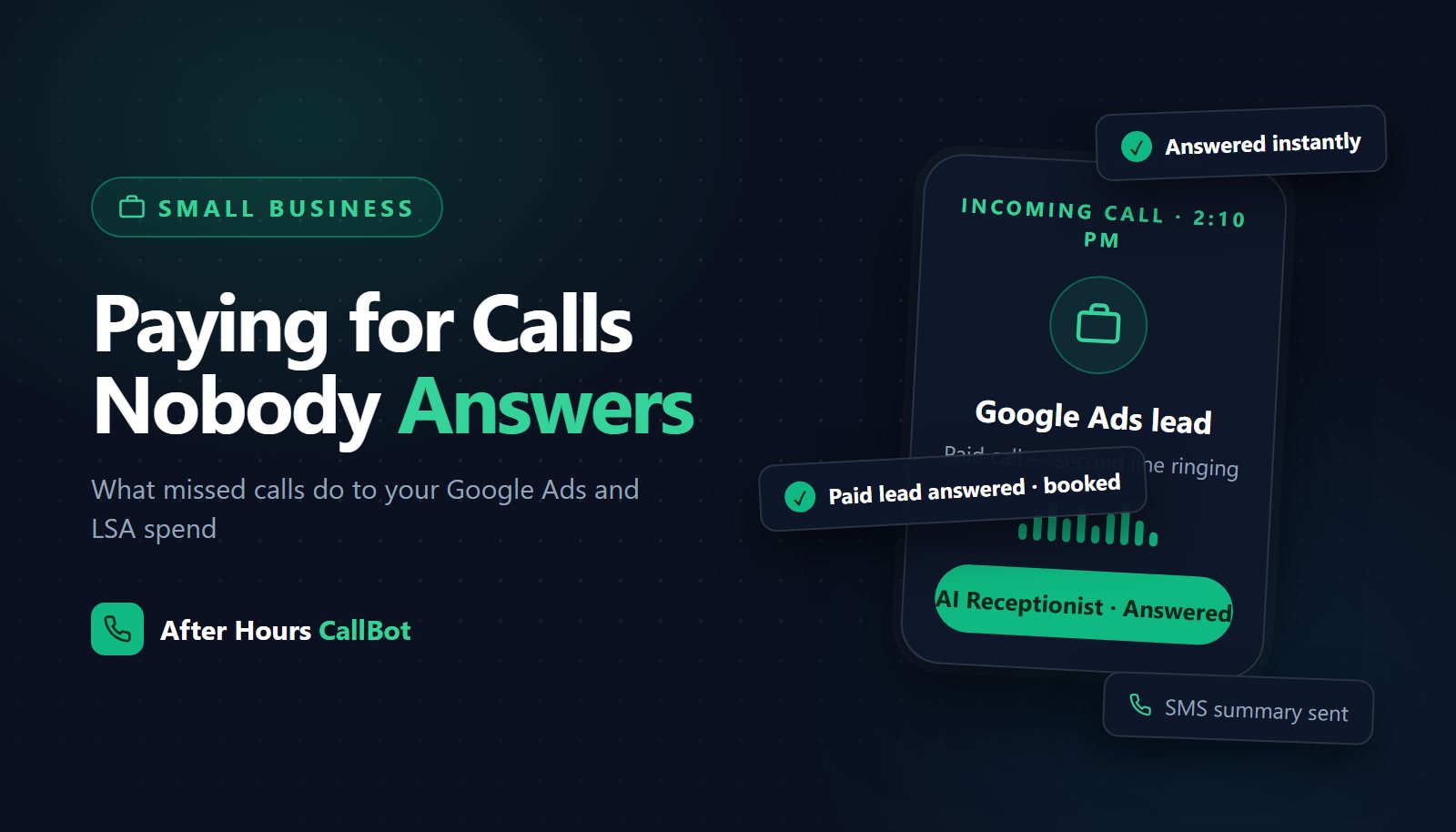
If you run Google Ads or Local Services Ads and you miss calls, you are losing the same lead twice. Once when you paid for it, and again when Google notices you didn't answer and shows your ad less.
That second part is not a theory. It is in Google's documentation. This page quotes it, does the math on a real cost per lead, and ranks the fixes by whether they survive the exact moment that breaks them: the afternoon your crews are out and two paid calls ring at once.
What Google actually says
Google's Local Services Ads help page on how ad rankings are determined lists the inputs. Alongside your bid and search relevance, ranking depends on "your responsiveness to customer inquiries and requests," and the page states plainly: "Missed calls may negatively affect your responsiveness." Profile quality is listed separately and includes "average response time." (Google Local Services Help: About ad rankings)
Read that as Google's operators intend it. LSA is a per-lead product. Google is paid when a lead connects, and a provider who lets paid calls ring out is a bad experience for the homeowner and a wasted auction for Google. So the system routes future leads toward providers who pick up. Every missed paid call is a small vote against showing you next time.
For standard Google Ads with call assets or call-only campaigns, there is no published responsiveness score. But the first cost, the lead you paid for and never spoke to, is identical.
The double cost, with numbers
You will need one input of your own: your cost per lead. It is in your LSA dashboard or your Ads account. If you don't have it handy, the figure KaiCalls cites from ServiceTitan's 2024 benchmarks for HVAC paid channels is $50–$200 per lead. (KaiCalls) Use your own number if you have it; it is the only one that matters.
Now the miss rate. Measured business-hours miss rates cluster between 20% and 35%: dental practices 20–32%, law firms 34.8% in a 1,200-call audit, HVAC 30% or more in peak season. (Scheduling Institute · Resonate · Legal Navigator · KaiCalls)
Cost 1, the wasted lead. A contractor spending $3,000 a month on paid calls at $100 per lead buys 30 calls. At a 30% miss rate, nine of them ring out. That is $900 a month, $10,800 a year, paid to Google for calls nobody heard. The lead is not "delayed": about 80% of callers sent to voicemail leave no message (CRM Magazine), and 75% of consumers choose a local business within 30 minutes (BrightLocal, 2026). A paid caller who hits voicemail has usually booked the next ad down within the half hour.
Cost 2, the lost job. Those nine callers were not browsing. They clicked a paid ad and dialed. If a third would have booked at a $375 HVAC repair ticket (Fixr, 2026), that is another $1,100 a month in revenue on top of the wasted spend; at a $10,000 roof replacement (Fixr, 2026) it is a different order of magnitude.
Cost 3, the one you can't see on any invoice. Lower responsiveness, fewer future LSA impressions, so the next month's $3,000 buys fewer leads than this month's did. Google does not publish the size of that effect. It only publishes that it exists.
Run cost 1 and cost 2 on your own inputs in the missed-call calculator.
Why the callback doesn't get the lead back
Every business that misses paid calls believes it calls back fast. Two problems.
The callback goes to an unknown number. Hiya's 2026 State of the Call, surveying 12,000+ consumers, found 86% of calls from unknown numbers go unanswered. (Hiya) The homeowner who called your ad from their cell now lets your cell go to their voicemail.
And "fast" is slower than it feels. The Harvard Business Review audit of 2,241 companies found 37% responded to a lead within an hour, 23% never did, and the average was 42 hours. (HBR, 2011) On LSA, Google measures your average response time and puts it in the profile-quality bucket. A callback that takes an hour is a callback Google has already counted against you.
When it breaks: the two-calls-at-once problem
Missed paid calls are not spread evenly across the month. They cluster.
They cluster in peak season, when ad volume, call volume and crew utilisation all spike together. KaiCalls' call data shows summer HVAC call volume running 200–400% above baseline, with miss rates of 30–50% during the first heat wave. Your LSA budget is spending fastest at exactly the moment you can least answer. We break this down in Why HVAC Companies Lose Their Best Leads in Peak Season.
They cluster in the weekday afternoon, when the office is unstaffed or on another line and every crew is out. The roofing version of that day is instructive: the calls you miss are at 2 PM, not 2 AM.
And they cluster in overflow: two paid calls in the same minute, one person to answer. The second caller is a paid lead that rang out while you were talking to the first. No staffing level fixes this, because the problem is concurrency, not effort.
The fixes, ranked by whether they survive the bad afternoon
| Option | Answers the paid call now? | Two paid calls at once? | Peak season? | Effect on LSA responsiveness |
|---|---|---|---|---|
| Forward to the owner's or foreman's cell | If they can stop and pick up | No | No | Helps until the first day it doesn't |
| Add a CSR or office staff | During their shift, one at a time | No | Partly | Helps until volume exceeds one person |
| Missed-call text-back | No; sends a text, the lead still has no appointment | Yes | Yes | Does not count as an answered call |
| Live answering service | If they pick up in time | Yes | Yes, at per-minute or per-call cost that spikes with volume | Helps |
| AI phone receptionist | Every call, first ring | Yes, unlimited simultaneous calls | Yes, flat rate | Helps |
The first two are what most contractors already do. They are why the miss rate is 30%. The last two are the only options where a paid call is answered every time, and only one of them has a cost that does not rise with the same peak that generates the calls.
What an AI receptionist does with a paid call
After Hours CallBot answers on the first ring, day or night, including the two-at-once and the 2 PM cases. Trained on your business, it answers the homeowner's actual questions (service area, what you do, whether you can come today), captures the job details an estimator needs, books into Google Calendar, Calendly or TidyCal during the call, and transfers true emergencies to your on-call phone on keywords you set. You get an email summary with name, reason and outcome after every call, and an SMS alert for urgent ones.
For LSA specifically, that means every paid call is an answered call, and your average response time is measured in seconds. The dental setup already includes this as a named feature, Google Ads ROI protection; the plumbing and other industry setups do the same.
Plans are $199, $299 and $499 a month with a 14-day trial and no card. Against $900 a month in wasted lead spend alone, the arithmetic is in Is an AI Receptionist Worth It?. Hear it take a call: (321) 504-5467.
What to measure this month
- Your paid-call miss rate. In the LSA dashboard, count leads marked as missed or unanswered against total phone leads. In Google Ads, compare call-asset calls received to calls connected.
- Your cost per missed paid call. Cost per lead × missed paid calls. Write it on the whiteboard.
- Your average response time, as Google sees it. If it is measured in hours, that is the number affecting your rank.
Then decide whether to keep paying it.
Frequently asked questions
- Do missed calls affect Google Local Services Ads ranking?
- Yes. Google's Local Services help page lists "your responsiveness to customer inquiries and requests" as a ranking input and states that "missed calls may negatively affect your responsiveness." Average response time is also part of profile quality.
- How much does a missed Google Ads call cost?
- The lead cost you already paid, plus the job. At $100 per lead and a 30% miss rate on 30 monthly calls, that is $900 a month in wasted spend before lost revenue.
- Does calling the lead back fix a missed LSA call?
- Rarely. 86% of calls from unknown numbers go unanswered, most consumers choose a business within 30 minutes, and Google measures your response time either way.
- Does missed-call text-back count as answering for LSA?
- No. A text acknowledges the call; it does not answer it, and the lead still has no appointment. Only a live answer, human or AI, closes the loop.
- What's the cheapest way to answer every paid call?
- A flat-rate AI receptionist, because its cost does not rise with the peak-season volume that generates the calls. After Hours CallBot is $199–$499 a month for unlimited simultaneous 24/7 answering.