
How Roofing Companies Lose Jobs at 2 PM on a Tuesday (When Every Crew Is on a Roof)
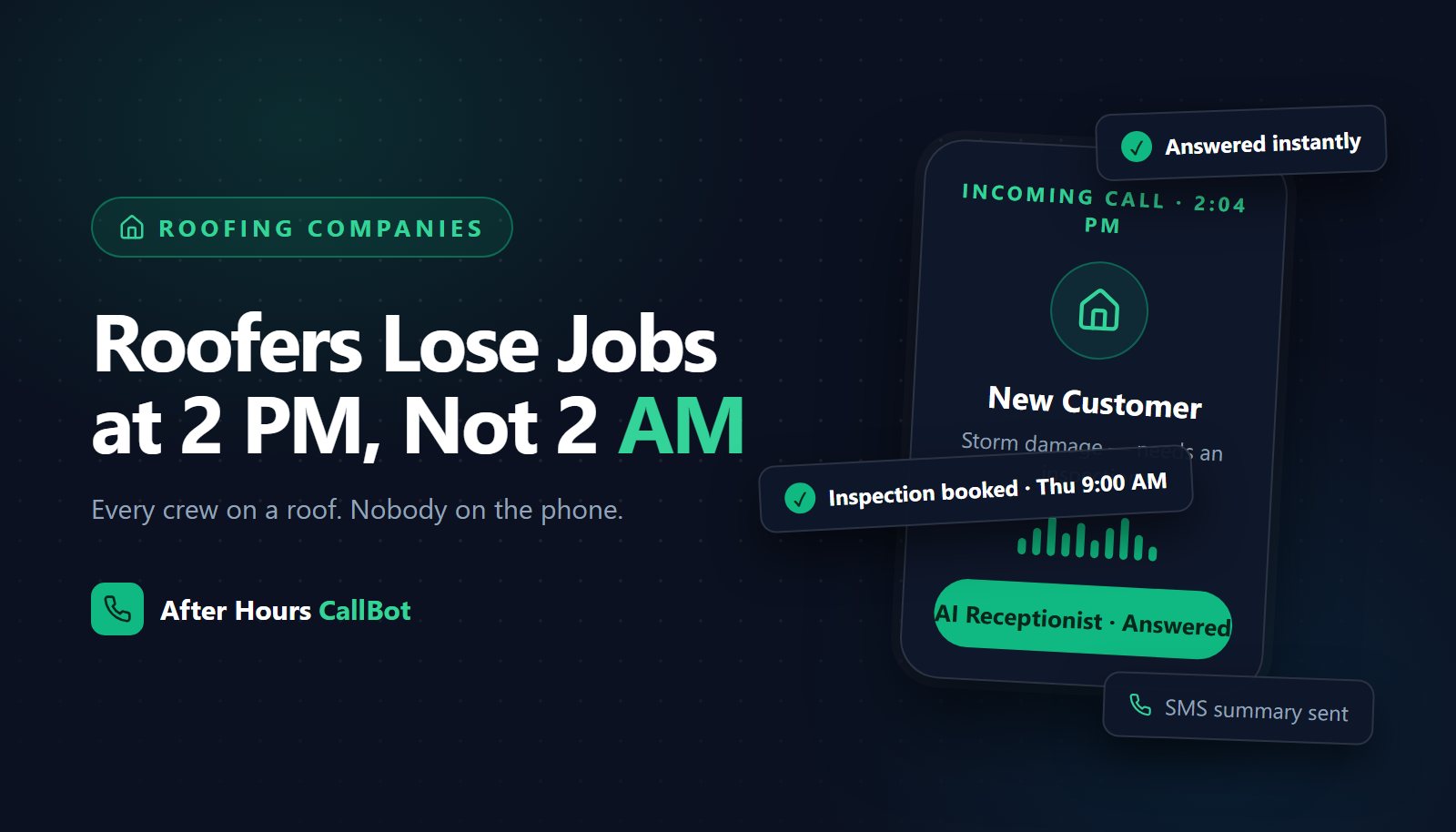
Ask a roofing owner when they miss calls and most will say "after hours." The call log usually says something else. The calls you lose are the ones that come in at 10:15 on a Tuesday morning while both crews are on roofs, at 12:30 while the office manager is at lunch, and at 2:00 while she is already on the line with a supplier.
That distinction matters, because the fixes for "after hours" and the fixes for "2 PM on a Tuesday" are different. Here is a normal day, what each missed call was worth, and what actually closes the gap.
A roofing company's day, from the phone's point of view
7:40 AM. Crews roll out. The office isn't open yet. A homeowner who noticed a leak overnight calls on the way to work. Voicemail.
10:15 AM. Both crews are on roofs. The foreman's phone is in the truck. Two calls come in ten minutes apart: one storm-damage inquiry, one "can you quote a replacement." Nobody hears either ring.
12:30 PM. The office manager takes lunch. Forty minutes of voicemail.
2:00 PM. She is back, on the phone with the supply house about tomorrow's delivery. A second line rings. It rings out.
4:30 PM. She works through the missed-call list. Most numbers left no message and no name. She calls three back. Two don't pick up an unknown number. One says they already booked an inspection with someone else.
8:50 PM. A homeowner who just got home and looked at the ceiling stain calls. Voicemail again. This one people notice, because it is the only one that happens when everyone is home. It is also the smallest bucket.
This timeline is a composite, and Awari Media's analysis of roofing call patterns makes the same point: the worst time for a roofing company's phone is a weekday afternoon, not the evening. (Awari Media)
What one of those calls was worth
Roofing has the highest ticket of any home-service trade that runs on inbound phone calls.
| Measure | Figure | Source |
|---|---|---|
| Average roof replacement, national | $10,000 (typical range $7,500–$14,000) | Fixr, 2026 |
| Average residential roofing job, as reported by a roofing answering-service provider | $7,500–$15,000 | Posh (unsourced; consistent with Fixr) |
| Cost per lead from Google Ads, HomeAdvisor or Thumbtack, as reported | $150–$300 | Posh (unsourced; treat as indicative) |
Do the conservative version of the math yourself. Say your company misses four calls a week during business hours, which is well under the one-in-three miss rates measured in other home-service trades. Say only one in four of those would have turned into a booked inspection, and one in two inspections into a job. That is roughly two jobs a month at a $10,000 average, or about $20,000 a month in replacement revenue that rang and went unanswered. During storm season the call volume triples and the miss rate rises with it.
Those inputs are assumptions, not measurements. Your own numbers give a better answer:
What the homeowner does when you don't pick up
They do not wait, and they do not leave a message.
- The most-cited figure on business voicemail, attributed to Forbes in a 2014 CRM Magazine analysis: 80% of callers sent to voicemail do not leave a message, because they don't think it will be heard. (CRM Magazine) The same piece quotes a live-answering CEO putting abandonment at 50–75% depending on the business, and Nuance research showing most voicemails sit at least eight hours before anyone listens.
- BrightLocal's 2026 survey of 1,227 US consumers: 75% choose a local business in under 30 minutes, and 72% consider three or fewer businesses. (BrightLocal) The homeowner who called you at 10:15 and got voicemail had, by 10:45, usually booked one of the other two roofers on their list.
And when you do call back from a cell phone, you hit the second wall. Hiya's 2026 State of the Call report, surveying more than 12,000 consumers, found 86% of calls from unknown numbers go unanswered. (Hiya) Your 4:30 callbacks are unknown numbers. We go through the voicemail behaviour in detail in Why Customers Don't Leave Voicemails Anymore.
The callback trap
Every roofing company believes it calls back fast. The best-known study of lead response, published in Harvard Business Review, audited 2,241 US companies and found that only 37% responded to a lead within an hour, 23% never responded at all, and the average response time among those that did was 42 hours. (Harvard Business Review, 2011)
Roofing companies are not slower than average. They are structurally unable to be fast, because the people who can quote a job are on a roof when the lead arrives. That is the whole problem in one sentence. Calling back at 4:30 is not a fix. It is the moment you find out the job is gone.
Storm season makes every number worse
After a hail event or a wind storm, three things happen at once. Inbound calls spike, often several times normal volume. Every crew is booked solid, so nobody is in the office. And every competitor in the county is running ads against the same homeowners, so the caller's "three or fewer businesses" shortlist is being filled within the hour.
The companies that win storm season are not the ones with the most trucks. They are the ones whose phone gets answered on the first ring at 2 PM while every truck is out.
Four ways to fix it, ranked by whether the caller gets an answer now
| Option | Caller gets an answer now? | Works at 2 PM with crews out? | Works in a storm spike? | Typical monthly cost |
|---|---|---|---|---|
| Ring group to the foreman's cell | Only if he can hear it and stop working | Rarely | No, he's on a roof | $0 plus lost focus |
| Hire an office manager (or a second one) | During their shift, one call at a time | Yes, until the second line rings | No, one person | Wages, benefits, coverage gaps at lunch |
| Live answering service | Yes, if they pick up in time | Yes | Yes, but per-minute pricing spikes with volume | Per-minute or per-call, plus after-hours premiums |
| AI phone receptionist | Yes, every call, first ring | Yes | Yes, unlimited simultaneous calls at a flat rate | Flat rate. After Hours CallBot: $199–$499/mo |
The first two are what most roofing companies already do, and they are why the 2 PM call is missed. The last two are the only options where the homeowner hears a voice instead of a beep.
What an AI receptionist actually does on a roofing call
It answers on the first ring, day or night, and it is trained on your company: your service area, the work you do and don't do, your inspection process, how you handle insurance claims. On a call it can:
- Capture the job details you need before an estimator can act: address, roof type, what the homeowner is seeing, whether there was a storm, whether they have started an insurance claim.
- Book the inspection straight into your calendar (Google Calendar, Calendly and TidyCal on every plan).
- Escalate the real emergencies. A keyword you set, such as "active leak" or "tree on the roof," triggers an immediate warm transfer to the on-call phone or an SMS alert.
- Take every call at once. During a storm spike it answers an unlimited number of simultaneous calls, so the tenth caller gets the same first-ring answer as the first.
- Text you the summary. Name, address, reason, outcome, after every call, with a full transcript in the dashboard, so the 4:30 callback becomes a 4:30 confirmation.
Setup is under ten minutes. Paste your website, pick a voice, forward your existing number. It answers in English and Spanish; other languages are by request.
Hear it take a call now: (321) 504-5467.
The arithmetic
Plans run $199, $299 and $499 a month, each with included call time and $0.12 a minute beyond it, with a 14-day free trial and no card required.
Against a $10,000 average replacement, the plan pays for itself the first time it answers a 2 PM call that would otherwise have gone to voicemail. Everything after that is margin. The roofing-specific setup, including storm-mode intake and insurance-claim capture, is on the roofing answering service page. If you also run general contracting, the contractor version covers the same gap.
Find out what your Tuesdays are costing. Run the numbers, then start a free 14-day trial and forward the office line for two weeks. Count the inspections that book while the crews are on roofs.
Related: what a roofing answering service costs, and which kind fits your crew.
Frequently asked questions
- When do roofing companies miss the most calls?
- During business hours, on weekday mornings and afternoons, when crews are on roofs and the office is unstaffed or on another line. After-hours calls are a smaller share than most owners assume.
- Do homeowners leave a voicemail for a roofer?
- Mostly no. The widely cited figure is that 80% of callers sent to business voicemail don't leave a message, and most consumers choose a contractor within 30 minutes of starting to search.
- What is a missed roofing call worth?
- The national average roof replacement is about $10,000, with a typical range of $7,500–$14,000. Even at a one-in-eight conversion from call to job, a missed call is worth well over $1,000 in expected revenue.
- Does an answering service work for roofing companies in storm season?
- A live service works but is usually billed per minute or per call, so costs spike with volume. An AI receptionist answers unlimited simultaneous calls at a flat monthly rate, which is why it fits storm surges.
- Can an AI receptionist book roof inspections?
- Yes. It checks real calendar availability during the call and books directly into Google Calendar, Calendly or TidyCal, then sends the details to your estimator by email and SMS.