

Roofing Answering Service: What It Costs, What It Should Do, and Which Kind Fits Your Crew
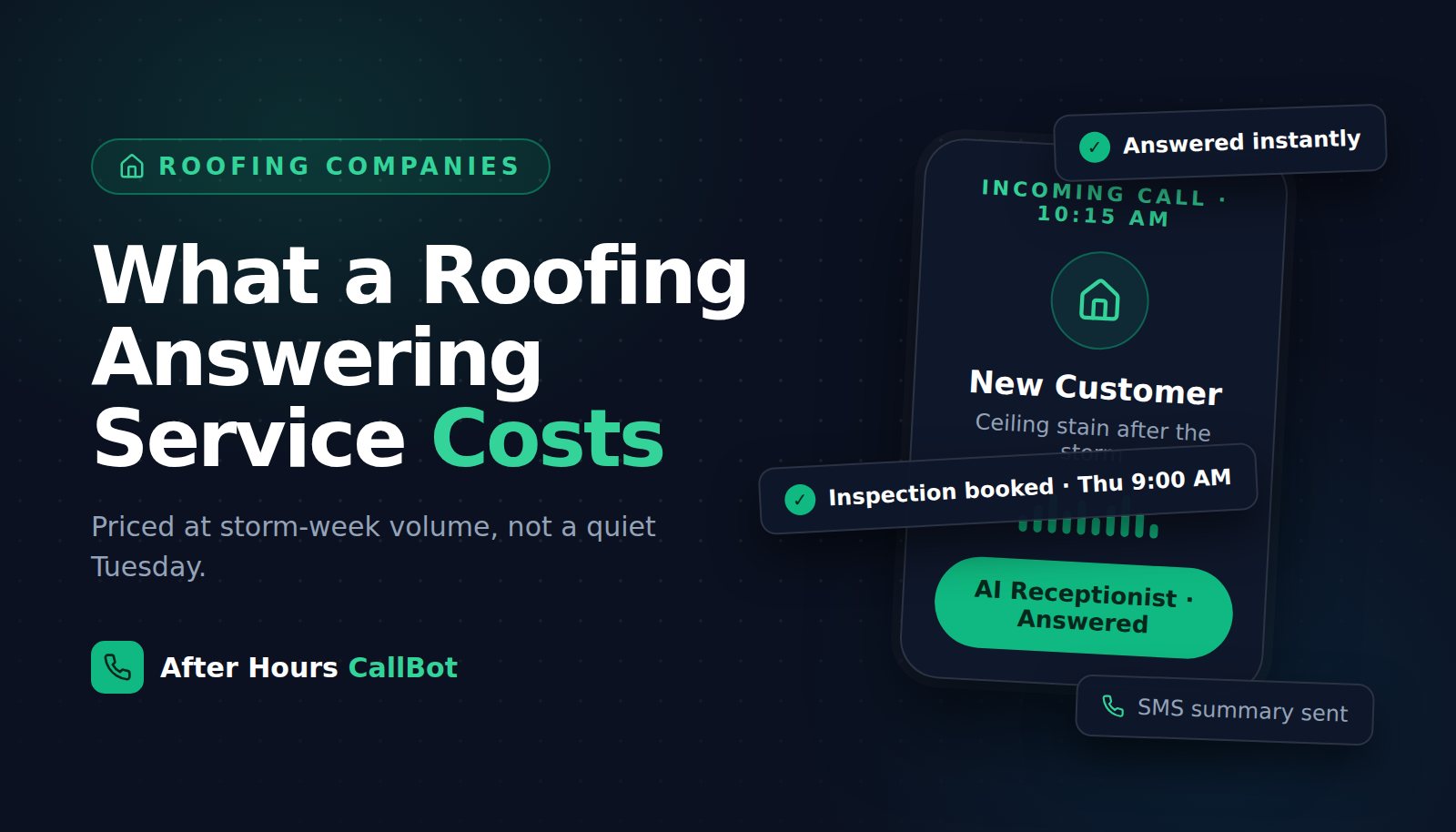
A roofing company's phone is answered by whoever is not on a roof, which from 8 AM to 4 PM is often nobody. We walked through a day of that in Roofers Lose Jobs at 2 PM, Not 2 AM. This post is the next step: if you have decided the phone needs covering, what a roofing answering service costs, what each kind does with a storm-damage call once it answers, and how to pick one that survives the week after a hailstorm.
What a roofing answering service has to handle
Roofing calls are not like dental calls. They are fewer, larger, and arrive in weather-driven bursts. A service that works for a roofer needs to do five things, and most of the options below fail at least one:
- Answer during the day, not just after hours. The roofing phone is missed at 10 AM and 2 PM, when every crew is working, more than at 10 PM.
- Qualify the lead. Leak or full replacement, insurance claim or cash, address, how soon. A "please call back" message loses most of that.
- Book the inspection into the estimator's actual calendar, so the homeowner has a Thursday 9 AM, not a promise.
- Scale on storm days. The week after hail, call volume can multiply. A service priced per minute or staffed with two operators becomes either expensive or busy, exactly when the jobs are biggest.
- Reach the owner for the real emergencies: an active leak over a nursery, a tree through a roof, a commercial client with water in the server room.
What the three kinds cost
Live operator answering service
Human operators answer in your company's name from a script and relay messages by text or email. Nextiva's 2026 pricing guide puts per-minute rates at $0.75–$1.50, per-call pricing at $1–$11, mid-range plans at $200–$600 a month and high-volume plans at $600–$1,000 or more, with appointment scheduling frequently an add-on at $20–$50 a month and setup fees from $50 to $500. (Nextiva, Answering Service Cost 2026) Roofing calls run long, because the homeowner describes the stain, the storm and the insurance adjuster. At five minutes a call and 80 calls a month, that is 400 minutes: about $500 a month at $1.25 a minute, before the scheduling add-on. In a storm month at 250 calls, it is $1,500 or more.
Office manager (or a second one)
A full-time office manager answers during business hours, one call at a time, and is also ordering material, chasing permits and invoicing. A dedicated phone hire at roughly $3,000–$4,000 a month in wages before taxes and benefits (an assumption; use your market) covers the shift and nothing after it, and still has one pair of hands on storm days.
AI phone receptionist
Software answers in a natural voice, trained on your company, qualifies the lead, books the inspection and texts you the details. Flat monthly rate: After Hours CallBot is $199 a month for 150 minutes, $299 for 400, or $499 for 1,000, overage a flat $0.12 a minute, booking included, no setup fee, no after-hours premium, unlimited simultaneous calls. The same 400-minute month is $299. The 250-call storm month on the Business plan is $499, with every call answered on the first ring whether three or thirty come in at once.
Side by side
| At 80 calls / 400 minutes a month | Live operator service | Office manager | AI receptionist |
|---|---|---|---|
| Monthly cost | ≈ $500 plus scheduling add-on, more in storm months | ≈ $3,000–$4,000 plus taxes and benefits | $299 (Pro), overage $0.12/min |
| Answers at 2 PM when every crew is on a roof | Yes | Yes, one at a time | Yes, all at once |
| Answers at 8:50 PM when the homeowner finds the stain | Yes, often at a premium | No | Yes, same rate |
| Qualifies: leak vs. replacement, insurance vs. cash, address | If it is in the script | Yes | Yes, by the questions you set |
| Books the inspection into the estimator's calendar | With an add-on and shared calendar | Yes | Yes, Google Calendar, Calendly, TidyCal |
| Storm week, call volume triples | Cost triples; hold times grow | Most calls ring out | Same plan, every call answered |
| Emergency to the owner's cell | By script | Yes | Keyword-triggered warm transfer or SMS |
| Summary after every call | Message relay | Verbal | Text and email with the lead's details |
What one answered roofing call is worth
The figures from our roofing missed-call post: Fixr puts the national average roof replacement at about $10,000, typical range $7,500–$14,000 (Fixr), and roofing leads from Google Ads or marketplaces run $150–$300 each. Harvard Business Review's audit of 2,241 companies found only 37% responded to a lead within an hour and 23% never did. (HBR, 2011) BrightLocal's 2026 survey found 75% of consumers choose a local business in under 30 minutes. (BrightLocal) A homeowner with a ceiling stain calls three roofers and books an inspection with the first one that answers. If a service answers one additional replacement inquiry a month that would have rung out, and a quarter of inspections close, that is one $10,000 job a quarter against a $299 plan. If you paid $200 to generate that lead, a missed call also wasted the $200. The ad-spend side of this is in Paying for Calls Nobody Answers.
Run your company's call volume and average job in the calculator →
What the AI receptionist does on a roofing call
It answers on the first ring, day or night, trained on your company: service area, residential or commercial, whether you handle insurance claims, financing, how fast you can get an estimator out. On a call it can:
- Qualify the lead with the questions you choose: is water coming in now, when was the storm, roof age, address, insurance claim filed or not.
- Book the inspection into real availability, so the homeowner hangs up with Thursday at 9 AM and the estimator sees it on his calendar.
- Escalate the emergencies. A keyword you set, such as "water coming in," "tree," or a commercial client's name, triggers a warm transfer to the owner or a text with the address.
- Take every storm-day call at once, which is the whole point in the week after hail.
- Text the office a summary after each call with the lead's name, number, address and what they described, so the follow-up is a confirmed appointment, not a cold callback.
Setup takes under ten minutes: paste your website, pick a voice, and forward your existing number on busy or no-answer so customers keep calling the one on the truck. English and Spanish, other languages by request. The roofing-specific flows, including storm-season routing, are on the roofing answering service page.
Hear it take a call now: (321) 504-5467. Tell it you have a leak.
How to choose
- If you need daytime overflow more than nights, which most roofers do, rule out anything that only covers after hours.
- If storm season is your year, price every option at three times your normal volume, not at your normal volume. Per-minute services get expensive at exactly the wrong time.
- If your estimator's calendar is the bottleneck, insist on real booking, not message-taking.
- Test it before you trust it. Call the vendor's demo line and describe your last emergency. Anything that cannot handle that call cannot handle your phone.
The arithmetic
Plans run $199, $299 and $499 a month, each with included call time and $0.12 a minute beyond it, with a 14-day free trial and no card required. One $10,000 replacement booked from a call that would have rung out pays for the Pro plan for nearly three years.
Find out what your missed calls are worth. Run the numbers, then start a free 14-day trial before the next storm, forward the office line, and count the inspections that book while the crews are on roofs.
Frequently asked questions
- How much does a roofing answering service cost?
- Live operator services bill about $0.75–$1.50 a minute, with mid-range plans around $200–$600 a month before scheduling add-ons, and costs climb in storm months. AI phone receptionists are flat-rate; After Hours CallBot runs $199–$499 a month with booking, 24/7 coverage and unlimited simultaneous calls included.
- Can an answering service book roof inspections?
- Live services can with a scheduling add-on and a shared calendar. An AI receptionist books into Google Calendar, Calendly or TidyCal availability on the call as part of the base plan.
- Does a roofer need 24/7 answering or just daytime coverage?
- Both, but daytime first. Most roofing calls are missed during working hours when crews are on roofs. Evening calls, when homeowners get home and notice damage, are the second gap. A flat-rate AI receptionist covers both at one price.
- What happens to call volume after a hailstorm?
- It can multiply several times over for a week or more. Per-minute services bill accordingly and hold times grow; an in-house desk rings out. An AI receptionist answers every call simultaneously at the same monthly rate.
- Can AI answer calls for a roofing company and tell real emergencies from estimates?
- Yes. You set the qualifying questions and the emergency keywords. An active leak triggers an immediate warm transfer or text to the owner; a replacement inquiry gets qualified and booked for an inspection.