

The Patient Called at 9 PM With a Broken Tooth. Who Answered?
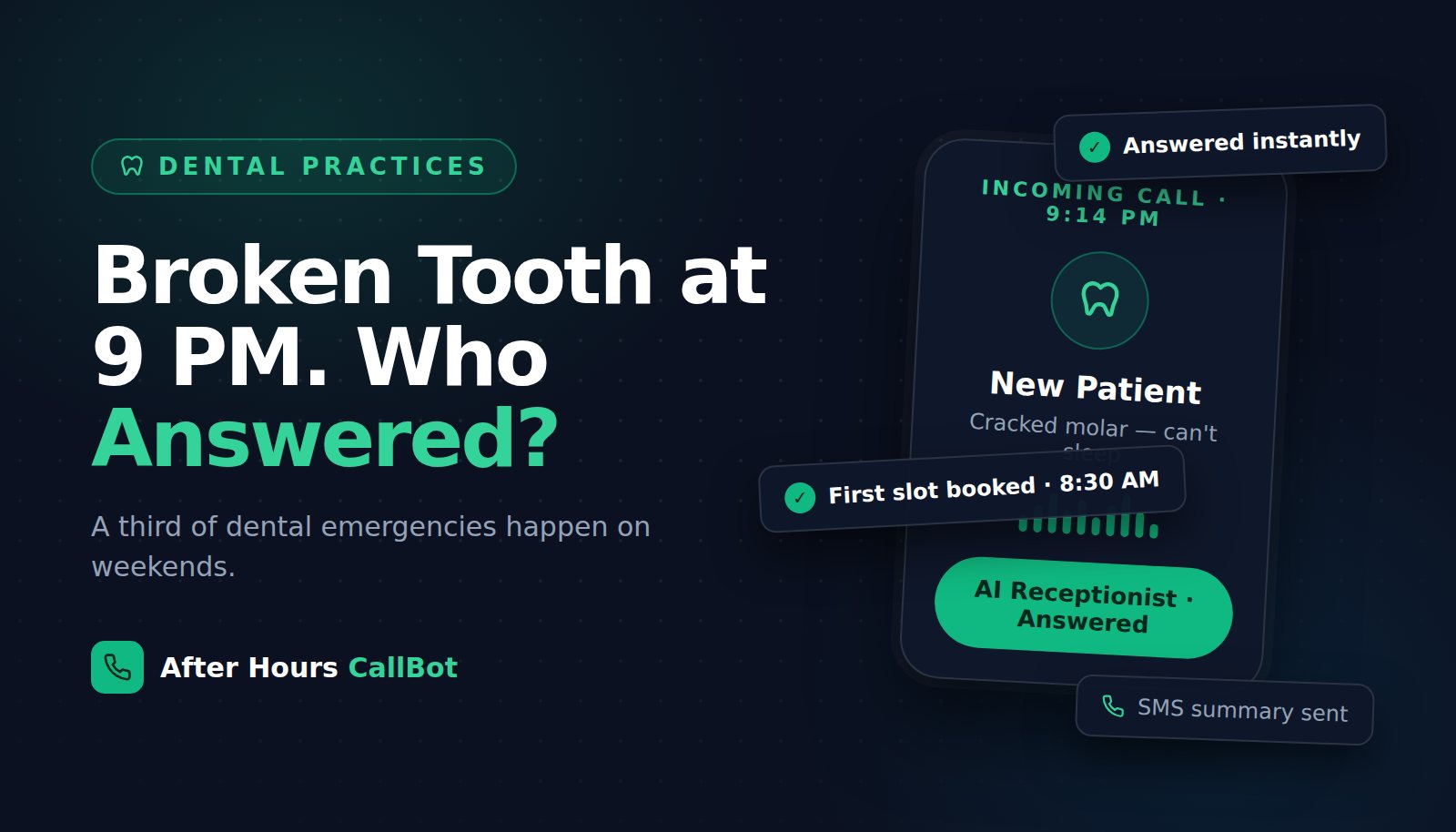
A dental office's phone has two lives. From 8 to 5 it is answered by a front desk that is also checking people in, verifying insurance and reminding the hygienist she is running late. From 5 PM until the next morning, and from Friday afternoon until Monday, it is answered by a recording. That second life is when a meaningful share of the calls that matter most arrive: the cracked molar at dinner, the child who fell at Saturday soccer, the new patient who finally has a quiet minute to find a dentist. An after-hours dental answering service exists to give that second life a voice. This post covers what the after-hours calls are, what they are worth, what the options cost, and what to look for.
Dental emergencies keep evening and weekend hours
The best data on when dental emergencies happen comes from hospital emergency departments, because when a dentist's office is closed that is where a patient in pain ends up. An analysis of the National Hospital Ambulatory Medical Care Survey found that 34% of nontraumatic dental ED visits occurred on weekends, against 29% on weekdays between 8 AM and 5 PM, and that visit rates ran 40–50% higher during non-working hours than the overall average. (Okunseri et al., NHAMCS analysis, PubMed) Those are the patients who could not reach a dentist. Each of them, at some point that evening, called one.
The ED does not fix teeth. Most of those patients get an antibiotic and a prescription for pain and are told to see a dentist. The practice whose phone picked up that night, told them what to do and gave them the first slot in the morning is the practice that gets the exam, the extraction or the crown, and often the family that comes with it.
What the after-hours caller actually does
They do not leave a voicemail. The most-cited figure on business voicemail, from a 2014 CRM Magazine analysis, is that 80% of callers sent to voicemail leave no message. (CRM Magazine) For dental practices specifically, the vendor figures we cited in Dental Practices Miss 1 in 3 Calls run even lower: only about 14% of new patients leave one. BrightLocal's 2026 survey of 1,227 US consumers found 75% choose a local business in under 30 minutes and 72% consider three or fewer. (BrightLocal)
So the patient with the cracked tooth calls your office, hears the recording, hangs up, and calls the next "emergency dentist near me" result. When your front desk returns the voicemail at 8:10 Monday, Hiya's 2026 State of the Call report says 86% of calls from unknown numbers go unanswered. (Hiya) The patient has already been seen. Why nobody leaves messages anymore is covered in Why Customers Don't Leave Voicemails.
What one after-hours dental call is worth
| The call | Typical value | Basis |
|---|---|---|
| Emergency exam plus same-day treatment (extraction, pulpotomy, temporary crown) | $300–$1,200 | Internal assumption; substitute your own fee schedule |
| New patient, first-year revenue | $500–$700 | Figures cited in our dental missed-call analysis |
| New patient, lifetime production over 7–10 years | at least $4,500; $15,000–$20,000 with referrals | Same |
| Existing patient calling about post-op pain | Retention of a patient worth the figures above | Same |
Run the conservative version. A two-dentist practice gets perhaps four after-hours calls a week that are real: two emergencies, one new patient who works days and could only call at 7 PM, and one existing patient. If two of the four book elsewhere because nobody answered, at $700 of first-year value each that is about $1,400 a week, or $70,000 a year, before any lifetime value. Those are assumptions, not measurements. Your own numbers are better:
The five ways to answer the dental phone after hours
| Option | Caller hears a voice now? | Can book into your schedule? | Weekend coverage? | Typical monthly cost |
|---|---|---|---|---|
| Voicemail with the "if this is an emergency" greeting | No | No | No | $0, plus the calls above |
| Forward to the on-call dentist's cell | If the dentist is free and picks up an unknown number | No, by hand later | Yes, one call at a time | $0, plus a dentist answering at dinner |
| Live medical/dental answering service | Usually, after a hold | Sometimes, with a shared calendar add-on | Yes, often with after-hours and holiday surcharges | $0.75–$1.50 a minute; typical plans $200–$600 a month at mid-range volume (Nextiva, 2026) |
| Online scheduling only, phone to voicemail | No | Yes, if the patient finds and uses it | Yes | Software fee |
| AI phone receptionist | Yes, every call, first ring | Yes, into real calendar availability | Yes, 24/7/365, unlimited simultaneous calls | Flat rate. After Hours CallBot: $199–$499/mo |
The live-service row deserves a note. A good human service is a real improvement on voicemail. The weaknesses are structural: the operator is reading your script, not your schedule; after-hours and weekend minutes often carry a premium; and the per-minute meter runs on every call, including the ten-minute one from a patient who wants to talk through whether the pain is bad enough to come in. The full cost comparison is in Dental Answering Service Cost: Live Operators vs. AI vs. In-House.
Does AI actually answer dental calls after hours?
Yes, and this is the question people search most, so here is exactly what happens. The AI receptionist answers on the first ring at 9:14 PM, trained on your practice: your hours, your providers, which emergencies you see same-day, your insurance list, where to park. On a call it can:
- Triage by the rules you set. Swelling that affects breathing or swallowing, uncontrolled bleeding, or a knocked-out adult tooth gets the instructions you specify, which can include "go to the emergency room now," then an immediate warm transfer or text to the on-call dentist. A cracked tooth with manageable pain gets the first slot in the morning.
- Book the appointment into real availability through Google Calendar, Calendly or TidyCal on every plan, so the patient hangs up with a time, not a promise to call back.
- Take the new-patient details: name, number, insurance, what is wrong, how they found you.
- Answer the questions that fill a weekend voicemail box: are you open Saturday, do you take this plan, is the office near the hospital, can I bring my kids.
- Text the practice a summary after every call, so Monday starts with a booked schedule and a short list of patients to call, not twenty minutes of listening to messages.
It answers in English and Spanish, with other languages by request. Setup is under ten minutes: paste your website, pick a voice, forward the office number after hours so patients keep calling the one on your Google listing. The dental-specific setup, including emergency triage flows and insurance questions, is on the dental office answering service page.
Hear it take a call right now: (321) 504-5467. Tell it you have a toothache.
What to look for in any after-hours dental answering service
- Real booking, not message-taking. A message that says "Mrs. Alvarez wants an appointment" is a callback you have to win on Monday. A booked 8:30 AM slot is a patient.
- Emergency routing you control. You decide which words trigger a transfer to the on-call dentist and which get a morning appointment. Ask any vendor to show you the rules, not describe them.
- Weekend and holiday coverage at the same price. If Saturday minutes cost more, the service is priced against the exact hours you bought it for.
- Simultaneous calls. Monday at 8:00 AM is the busiest ten minutes of a dental week. If the service handles one call at a time, the rest are still going to voicemail.
- A plain summary after every call, by text or email, with the caller's number, so nothing has to be transcribed from a recording.
- HIPAA awareness. The service should limit what it collects over the phone to scheduling details and should be willing to sign a business associate agreement if your compliance policy requires one. Ask.
The arithmetic
Plans run $199, $299 and $499 a month, each with included call time and $0.12 a minute beyond it, with a 14-day free trial and no card required. Against one $700 new patient a month, the Starter plan is paid for three times over. Against one emergency extraction and the family that follows it, it is paid for the first weekend.
Find out what your after-hours calls are worth. Run the numbers, then start a free 14-day trial, forward the line at 5 PM on Friday, and read Monday's summaries.
Frequently asked questions
- What is an after-hours dental answering service?
- A service that answers a dental office's phone when the front desk is closed: evenings, weekends and holidays. It can be a live operator service, a forwarded on-call cell, or an AI phone receptionist that answers, triages and books appointments 24/7.
- Does AI answer dental calls after hours?
- Yes. An AI receptionist answers on the first ring at any hour, follows the triage rules the practice sets, books into the practice's real calendar, transfers true emergencies to the on-call dentist, and texts the office a summary of every call.
- How much does a 24/7 dental answering service cost?
- Live answering services typically bill $0.75–$1.50 a minute, with mid-range plans around $200–$600 a month and often a premium for after-hours and weekend minutes. After Hours CallBot is a flat $199–$499 a month with 24/7 coverage included.
- Will patients with a real emergency still reach a dentist?
- Yes. You define the emergency keywords and the response. A call that matches can be told to go to the ER, warm-transferred to the on-call dentist, or both, immediately.
- Is an AI dental answering service HIPAA compliant?
- The service should collect only what scheduling requires over the phone and should be willing to sign a business associate agreement if your compliance policy calls for one. Ask any provider for their position in writing before you forward the line.