

What a Dental Answering Service Costs in 2026 (and What Each Kind Does With the Call)
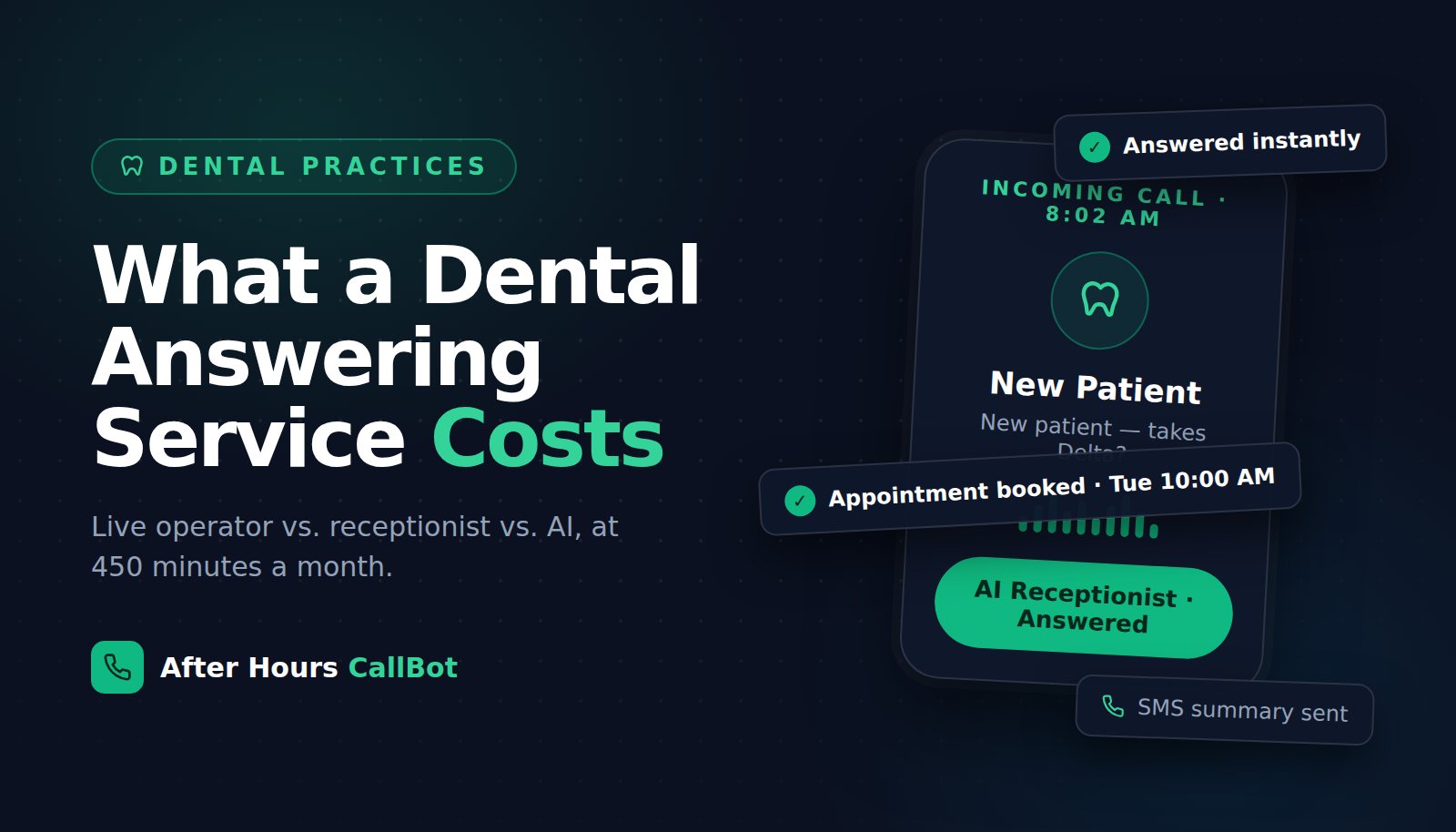
Search "dental answering service" and you get a page of vendors, each with a pricing page that needs a calculator and a glossary. This is the comparison those pages don't give you: what the three kinds of dental answering service actually cost per month at the call volume of a typical practice, what each one does with a call once it answers, and the one number that decides whether any of them is worth it.
Why the dental phone needs more than a front desk
The vendor studies we reviewed in Dental Practices Miss 1 in 3 Calls put the typical practice's miss rate at 28–32% of incoming calls, and 98% of new patients call before their first visit. The misses cluster at the same three moments: Monday morning when everyone calls at once, lunch when the desk is down to one person, and after 5 PM and on weekends when it is nobody. A front desk cannot fix the first two by trying harder and cannot fix the third at all. An answering service is the fix for all three, if it is the right kind.
The three kinds, and what each costs
1. Live operator answering service
Human operators at a call center answer in your practice's name from a script. Billing is nearly always per minute of operator time, sometimes per call. Nextiva's 2026 pricing guide puts per-minute rates at $0.75–$1.50, per-call pricing at $1–$11, entry plans at about $75–$200 a month, mid-range plans at $200–$600 a month, and high-volume plans at $600–$1,000 or more. Named examples from the same guide: Ruby at $250 a month for 50 minutes rising to $1,725 for 500, AbbyConnect at $329 for 100 minutes and $599 for 200, AnswerConnect with a $49.99 setup fee and $2.50 per extra minute. Appointment scheduling is frequently an add-on at $20–$50 a month, call recording another $10–$30. (Nextiva, Answering Service Cost 2026)
At a dental practice's volume, which is a lot of short calls plus a few long ones, the meter matters. Say the service handles 150 calls a month averaging three minutes: 450 minutes. At $1.25 a minute that is $560 before the scheduling add-on, the after-hours premium many services charge, and overage when a hygienist is out and the phone gets busier.
2. In-house: a second receptionist or an overflow line
Adding a part-time front-desk hire fixes the 8 AM and lunch gaps during that person's shift and nothing outside it. A part-time receptionist at 20 hours a week costs roughly $1,800–$2,400 a month in wages before payroll taxes, benefits and training (an assumption based on typical US front-desk wages; use your own market). It is the most expensive option per hour of coverage and the only one that cannot cover nights or weekends without overtime.
3. AI phone receptionist
Software answers the phone in a natural voice, trained on your practice, and does the whole job: answers questions, triages, books into your real calendar, and texts you a summary. Billing is a flat monthly rate with included minutes. After Hours CallBot is $199 a month for 150 minutes, $299 for 400, or $499 for 1,000, with overage at a flat $0.12 a minute, booking included, no setup fee, no after-hours or weekend premium, and unlimited simultaneous calls. The same 450-minute month above costs $305 on the Pro plan, with nothing extra for the Saturday calls.
Side by side at a typical practice's volume
| At 150 calls / 450 minutes a month | Live operator service | Part-time receptionist | AI receptionist |
|---|---|---|---|
| Monthly cost | ≈ $560 plus add-ons and after-hours premiums | ≈ $1,800–$2,400 plus taxes and benefits | $299 (Pro), overage $0.12/min |
| Answers at 9 PM and on Saturday | Yes, often at a premium rate | No | Yes, same rate |
| Handles Monday 8:00 AM when six patients call at once | One at a time per operator assigned | One at a time | All six, simultaneously |
| Books into your schedule | With an add-on and a shared calendar | Yes | Yes, Google Calendar, Calendly, TidyCal |
| Knows your insurance list, providers and hours | What is in the script | Yes | Yes, trained on your website and notes |
| Overflow when the desk is busy | Yes, if you forward on no-answer | Only during the shift | Yes, forward on busy or no-answer |
| Emergency triage and transfer | By script | Yes | By rules you set, with warm transfer |
| Summary after every call | Message relay, often by email | Verbal or sticky note | Text and email, with caller's number |
The only number that matters: what a captured patient is worth
Pricing pages compete on the monthly fee. The right comparison is the fee against what each service recovers. Using the figures from our dental missed-call analysis, a new patient is worth $500–$700 in first-year revenue and at least $4,500 over 7–10 years, more with referrals. A service that captures one additional new patient a month pays for the AI plan several times over and roughly breaks even on a live service. The question for each option is therefore not "how much does it cost" but "how many of the calls it answers turn into booked patients." That is where the kinds diverge:
- A live service that takes messages hands the front desk a callback list. Callbacks to unknown numbers mostly go unanswered, so a share of those messages never become patients.
- A receptionist books patients during the shift and nobody books them outside it.
- An AI receptionist books the patient on the call, at any hour, so there is no callback to lose. The break-even math by industry is worked through in Is an AI Receptionist Worth It?
Put your practice's call volume and patient value into the calculator →
Overflow: the use case most practices actually need first
Many practices search for an after-hours service and discover their biggest leak is 8:00 to 9:30 AM and lunch, when the office is open and the phone is simply busy. The vendor data above puts weekday daytime misses at the majority of the total. The fix is the same service, forwarded on busy or after four rings instead of only at closing time. A live service charges for those daytime minutes at the same meter. An AI receptionist on a flat plan takes the overflow at no change in price, and takes all of it at once. Ask any vendor specifically how they handle "forward on busy," because that is where the Monday patients are.
What the AI receptionist does on a dental call
Trained on your practice in under ten minutes from your website: providers, hours, insurance accepted, which emergencies you see same-day, new-patient paperwork, parking. On a call it books into real availability, takes new-patient details, answers the recurring questions, follows your triage rules for emergencies with a warm transfer to the on-call dentist when a rule matches, and texts a summary to the office. English and Spanish, other languages by request. The dental setup, including the after-hours flows, is on the dental office answering service page, and what happens on a night or weekend call is in our after-hours dental answering service guide.
Hear it take a call now: (321) 504-5467. Ask whether it takes your insurance.
The arithmetic
Plans run $199, $299 and $499 a month, each with included call time and $0.12 a minute beyond it, with a 14-day free trial and no card required. Against a $560 live-service month that still ends in callback lists, the Pro plan is cheaper and books the patient on the call. Against a second receptionist, it is about an eighth of the cost and covers the hours the receptionist cannot.
Find out what your missed calls are worth. Run the numbers, then start a free 14-day trial, forward the line on busy and after hours, and compare Monday's summaries with Monday's voicemail.
Frequently asked questions
- How much does a dental answering service cost?
- Live operator services bill about $0.75–$1.50 a minute, with mid-range plans around $200–$600 a month before add-ons such as appointment scheduling and after-hours premiums. AI phone receptionists are flat-rate; After Hours CallBot runs $199–$499 a month with booking and 24/7 coverage included.
- What is the best answering service for a dental office?
- The one that books the patient on the call rather than taking a message, covers nights and weekends at the same price, handles several calls at once on Monday morning, and follows your emergency triage rules. Compare on those four points rather than on the headline monthly fee.
- Can an answering service book dental appointments directly?
- Live services can with a scheduling add-on and access to a shared calendar. An AI receptionist books into Google Calendar, Calendly or TidyCal availability as part of the base plan, so the patient hangs up with a confirmed time.
- What is a dental call overflow service?
- The same answering service, forwarded when the office line is busy or rings unanswered during the day, so Monday-morning and lunchtime callers reach a voice instead of voicemail. With an AI receptionist the overflow calls are answered simultaneously at no extra charge.
- Is an AI receptionist cheaper than hiring a second receptionist?
- Substantially. A part-time receptionist costs roughly $1,800–$2,400 a month in wages before taxes and benefits and covers only their shift. An AI receptionist is $199–$499 a month and covers every hour, including nights and weekends.