
Dental Practices Miss 1 in 3 Calls. Here's What Each One Was Worth.
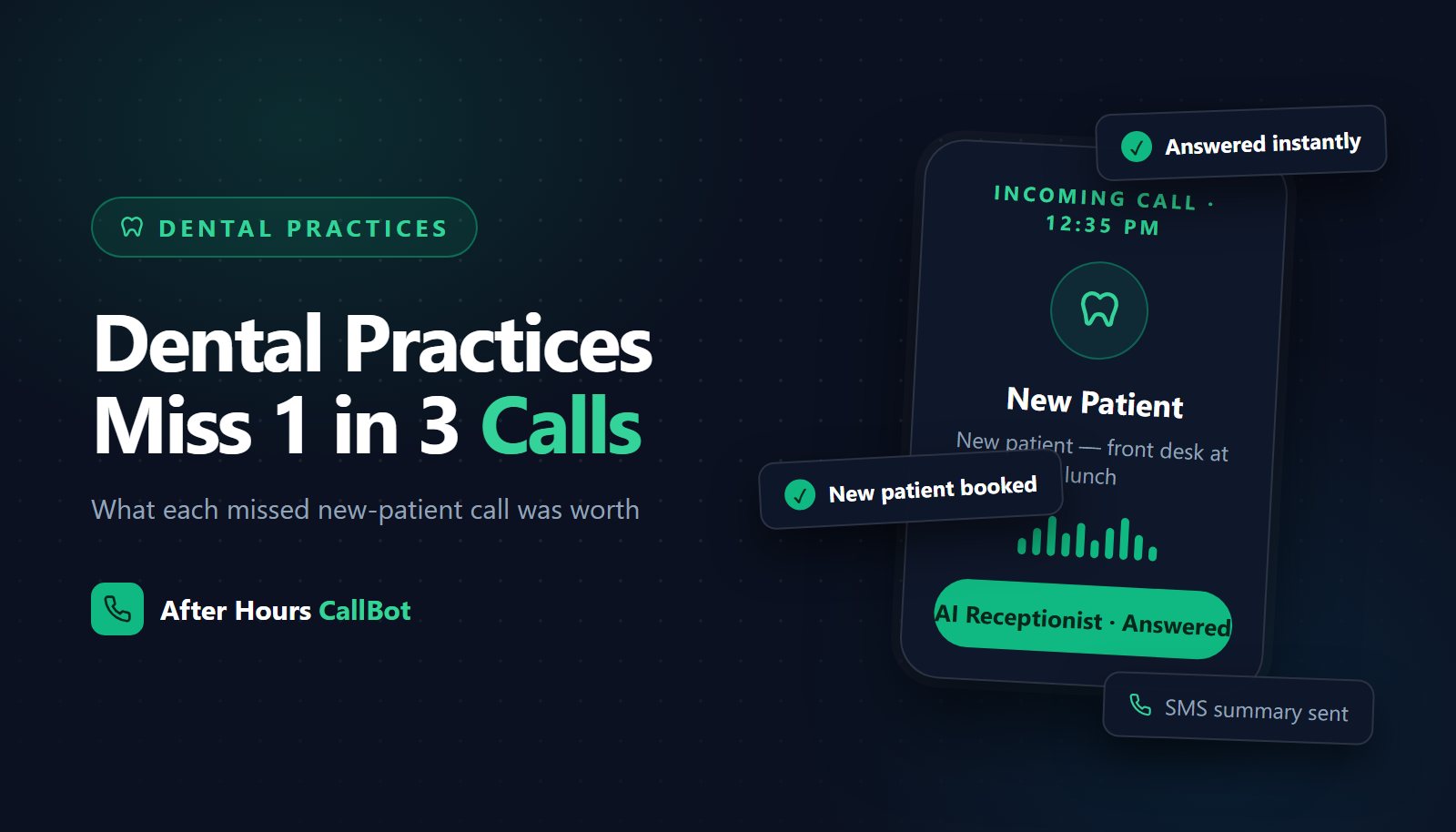
Most dental practices have no idea how many calls they miss. The phone system doesn't total it up, the front desk can't count what it never heard, and the callers who mattered most left no trace: they hung up and dialed the next practice on the map.
The numbers that exist are consistent, and they are worse than most owners assume.
How many calls a dental office actually misses
Three separate data sets land in the same range:
- Scheduling Institute, from call-tracking data across its client practices, puts the share of new-patient calls that go unanswered during business hours at 20–30% or more. (Scheduling Institute)
- The USA Dental Report, as cited by Resonate, measured 28–32% of incoming calls missed. (Resonate)
- PatientXpress models a practice on a 30% miss rate and describes it as typical. (PatientXpress)
Call it one in three. For a practice taking 60 calls a day, that is 18 calls a day nobody answered, and it is happening during the hours you are open and staffed.
Why the front desk can't win this on its own
This is not a staffing-effort problem. It is a geometry problem.
Your front desk answers the phone between everything else it does: checking in the 9:00, taking a payment from the 8:30, confirming tomorrow's hygiene column, and helping the patient at the window who has a question about their insurance. Every one of those tasks is a legitimate reason not to pick up on the second ring. Two calls at once means one of them waits or drops. Lunch is 40 minutes of voicemail. Then the office closes, and the 10 PM broken tooth goes to a recording.
Meanwhile the calls you most need to catch are exactly the ones that arrive at random. Scheduling Institute cites industry research that 98% of new patients call the office before their first visit. New patients do not book through the website and then call to say hello. The phone is the front door, and a third of the time it is locked.
What one missed new-patient call is worth
Use conservative figures, not the biggest number you can find.
| Measure | Figure | Source |
|---|---|---|
| First-year revenue from a new patient | $500–$700 | PatientXpress |
| Cumulative production over 7–10 years (based on ADA average annual dental spending) | at least $4,500 | Scheduling Institute |
| With referrals from that patient | $15,000–$20,000 | Scheduling Institute (their own analysis; treat as an upper bound) |
| National average new patients per month, solo practice | 27 | Scheduling Institute |
Take the middle figure. A practice that answers 27 new-patient calls a month is, at a 30% miss rate, failing to answer roughly 12 more that it never saw. Not all of those would have booked. If a third of them would have, that is four new patients a month, or about $18,000 a year in first-year revenue and roughly $216,000 in lifetime production, walking to the practice down the street.
Those are illustrative figures built from the sources above, not measurements from your practice. Your own inputs, your own answer:
What the caller does in the next 30 seconds
The instinct is that a serious patient will leave a voicemail. The data says they mostly won't:
- PatientXpress cites healthcare-consumer research showing more than 75% of patients who reach voicemail hang up without leaving a message.
- The USA Dental Report figure is starker: only 14% of new patients leave a voicemail. (Resonate)
- Dental Economics research, cited by Scheduling Institute, found 67% of dental callers immediately call a competitor when they can't reach someone.
And they decide fast. BrightLocal's 2026 survey of 1,227 US consumers found 75% choose a local business in under 30 minutes, and 72% evaluate three or fewer businesses before deciding. (BrightLocal) A new patient who reached your voicemail at 12:35 has, by 1:05, usually already booked with one of the two other practices on their list.
A callback at 2:15 is not late. It is irrelevant. The full picture of how callers behave when they reach a recording is in Why Customers Don't Leave Voicemails Anymore.
The three places dental practices leak calls
1. Overflow, during the day. Two lines ring, one gets answered. The second caller hears ringing, then voicemail. This is the largest bucket and the least visible, because the office feels busy, not negligent. This is what the queries "dental call overflow service" and "when the front desk is busy" are really asking about.
2. Lunch and short-staffed afternoons. The 40 minutes a day when the whole team steps away, plus every sick day and every hygienist-only afternoon.
3. After hours. Nights, weekends, holidays. The emergency patient with a cracked molar at 10 PM is the highest-intent caller you will ever get, and the "dental office after hours voicemail" greeting is the moment you lose them. They are not going to wait until Monday. They are going to call the practice whose listing says 24/7.
Four ways to stop the leak, ranked by what the caller gets
The right question is not "how do we get to the phone faster." It is "does the caller get an answer now?" Rank the options by that.
| Option | Caller gets an answer now? | Covers overflow? | Covers after hours? | Typical monthly cost |
|---|---|---|---|---|
| Train the front desk, add a second line | Sometimes | No (two people, two lines, third call still drops) | No | Staff time |
| Add a part-time receptionist | During their shift | Partly | No | $1,500–$2,500+ (wage only) |
| Live answering service | Yes, if they pick up in time | Yes | Yes, usually at an after-hours premium | Per-minute or per-call; rises with volume |
| AI phone receptionist | Yes, every call, first ring | Yes, unlimited simultaneous calls | Yes | Flat rate. After Hours CallBot: $199–$499/mo |
The first two are the ones most practices try, because they feel like "doing the right thing." They do not touch the overflow problem, and they do nothing at 10 PM.
Does AI actually answer dental calls after hours?
Yes, and it is worth being precise about what that means, because "AI receptionist" covers a lot of ground.
An AI receptionist built for practices like After Hours CallBot answers every inbound call, day or night, on the first ring. It is trained on your practice: your services, hours, insurance policy, new-patient process, and the answers to the questions your front desk repeats forty times a day. On a call it can:
- Book directly into your calendar. Google Calendar, Calendly and TidyCal are supported on every plan; it checks real availability and books during the call, so the 10 PM caller has an appointment before they hang up.
- Triage emergencies. Keywords you choose, such as "broken tooth," "swelling," or "bleeding," can trigger an immediate warm transfer to the on-call dentist or an SMS alert to your phone.
- Handle the whole overflow. It answers an unlimited number of calls at the same time, so the second and third simultaneous callers get the same first-ring answer as the first.
- Tell you what happened. Every call produces an email summary with the caller's name, reason and outcome, and a full transcript in the dashboard.
Two honest notes. It answers in English and Spanish today; other languages are by request. And by default it is not configured as a HIPAA-covered service; if your workflow requires a Business Associate Agreement before protected health information is stored, contact the team before you go live. Those are the questions to ask any vendor, ours included.
You can hear it handle a call right now by dialing the demo line: (321) 504-5467.
What this costs against what it recovers
After Hours CallBot's plans run $199, $299 and $499 a month, each with a block of call time and $0.12 a minute beyond it. There is a 14-day free trial with no card required.
Against the figures above, the arithmetic is short. One additional new patient a month, at $500–$700 in first-year revenue, covers the Starter plan on its own, before lifetime production or referrals. Most practices that measure their miss rate find they are recovering several.
If you want the full breakdown of how AI answering is priced against live services, it is in our 2026 cost guide, and the break-even by industry is in Is an AI Receptionist Worth It?. If you want the dental-specific setup, including emergency triage and new-patient intake, that is on the dental office answering service page.
Ready to see what your practice is missing? Run the numbers, then start a 14-day free trial and forward your line for two weeks. Count the new patients.
Related: what an after-hours dental answering service does on a 9 PM call, and what a dental answering service costs in 2026, live operators vs. AI vs. in-house.
Frequently asked questions
- How many calls does the average dental office miss?
- Independent data sets put it between 20% and 32% of incoming calls during business hours, so roughly one in three. Most of those calls are missed while staff are with patients, not after the office closes.
- What is a new dental patient worth?
- Around $500–$700 in first-year revenue, and at least $4,500 in cumulative production over 7–10 years using ADA average spending data. Referrals push the lifetime figure higher.
- Do patients leave a voicemail if the dental office doesn't answer?
- Mostly no. Figures range from 14% to 25% of callers leaving a message. About two-thirds call another practice instead.
- What should a dental office do about after-hours calls?
- Stop sending them to voicemail. The options are an on-call phone, a live answering service, or an AI receptionist that answers every call, books into your calendar and transfers true emergencies to the dentist on call.
- Can an AI receptionist handle overflow calls when the front desk is busy?
- Yes. Unlike a person or a phone line, an AI receptionist answers an unlimited number of simultaneous calls, so the second caller never hears voicemail because the first one is still talking.