
Acute Pain Doesn't Wait for Monday Morning — Why Chiropractors Lose New Patients to Voicemail
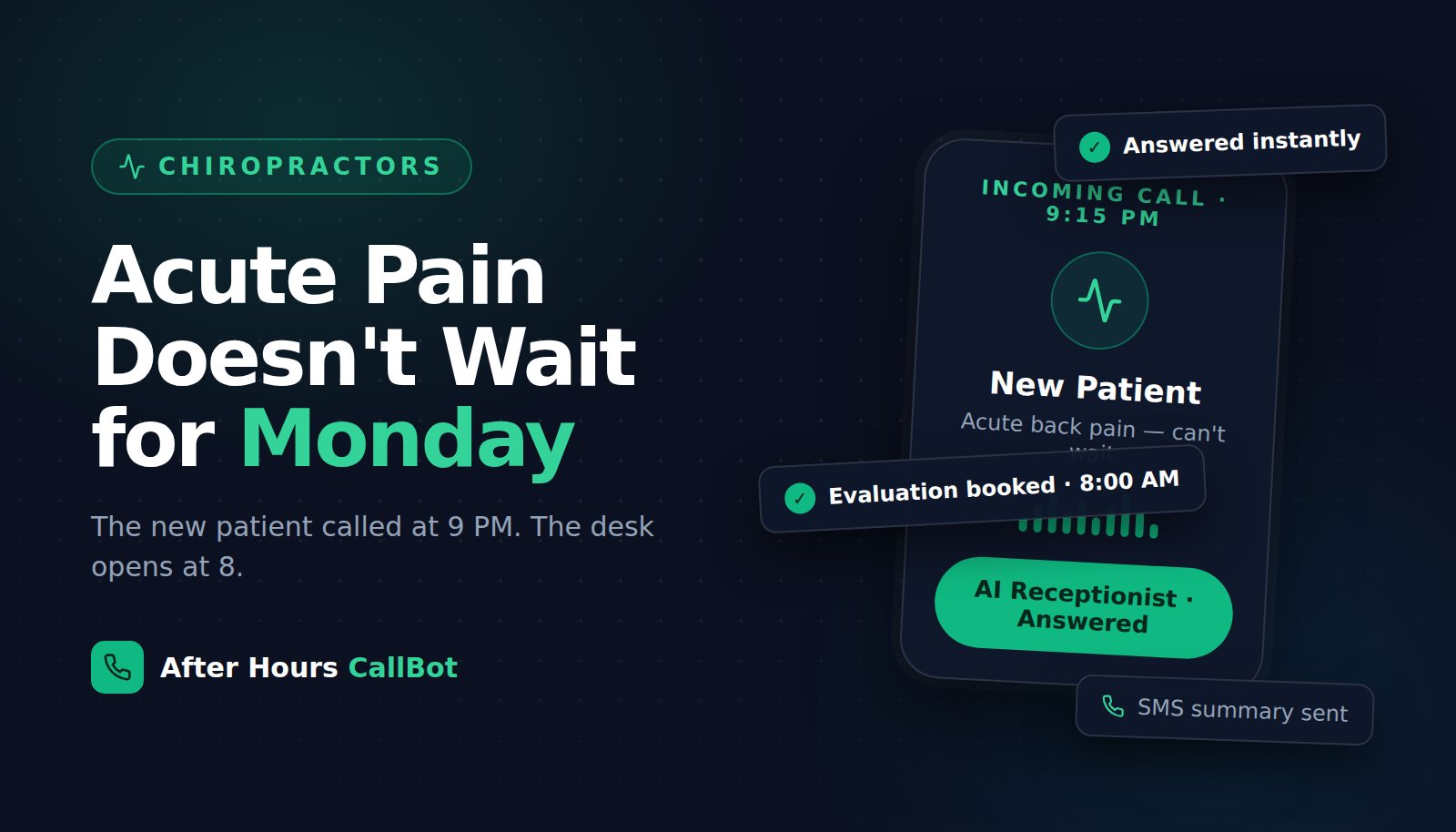
A roofer loses calls at 2 PM because the crew is on a roof. A chiropractor loses them for the opposite reason: the patient's back doesn't start screaming until after work. Acute pain keeps its own hours — it flares at 9 PM on the couch, at 3 AM when they try to roll over, on Saturday after a pickup game — and almost none of those hours are ones your front desk is staffed for.
That is why the Monday morning voicemail queue is the most expensive object in a chiropractic office. Every message in it is someone who was in pain, ready to book, and willing to pay — sixty hours ago.
Why the chiropractic call pattern is different
Most service businesses miss calls because everyone is busy. A chiropractic office misses them because of when the phone rings and who is free to answer it.
- Pain is an evening and weekend event. Desk workers notice the stiffness after eight hours in a chair, not at 10 AM. Weekend athletes tweak something on Saturday. Sleep-related flare-ups announce themselves overnight. The call happens when the pain peaks, not when you are open.
- The one person who can answer is in an adjusting room. A solo or two-doctor practice runs on one chiropractic assistant. When she is rooming a patient, processing a copay, or on hold with an insurer, the second line rings out. This is not a staffing failure; it is arithmetic.
- Your highest-value calls are your longest calls. A personal-injury or attorney referral inquiry is not a thirty-second booking. It needs the accident date, the claim number, the adjuster, the attorney, the body parts involved. Nobody takes that call properly between patients.
- New patients shop harder than returning ones. A maintenance patient will wait for a callback because they already trust you. Somebody in acute pain who has never met you will not.
What the patient in pain actually does next
They do not wait, and they do not leave a message. The research on caller behaviour is consistent across every industry that lives on inbound calls:
- The most-cited figure on business voicemail, attributed to Forbes in a 2014 CRM Magazine analysis: 80% of callers sent to voicemail do not leave a message, because they don't believe it will be heard. The same piece quotes Nuance research showing most voicemails sit at least eight hours before anyone listens. (CRM Magazine)
- BrightLocal's 2026 survey of 1,227 US consumers: 75% choose a local business in under 30 minutes, and 72% consider three or fewer businesses. (BrightLocal) Somebody searching "chiropractor near me" at 8:40 PM has usually picked one by 9:10.
- And when you call back the next morning from the office line, Hiya's 2026 State of the Call report — surveying more than 12,000 consumers — found 86% of calls from unknown numbers go unanswered. (Hiya)
We go through this behaviour in more depth in Why Customers Don't Leave Voicemails Anymore.
The Monday callback is not a save
Every practice believes it returns calls quickly. The best-known study of lead response, published in Harvard Business Review, audited 2,241 US companies and found only 37% responded to a lead within an hour, 23% never responded at all, and the average response time among those that did was 42 hours. (Harvard Business Review, 2011)
Forty-two hours is roughly Friday evening to Monday morning. For a patient in acute pain, that is not a slow response — it is an eternity, and they have already been adjusted by somebody else. Working through the voicemail queue on Monday is not recovering those patients. It is the moment you find out how many you lost.
What a missed new-patient call is worth
Chiropractic economics make this expensive in a specific way: the value is not one visit, it is the care plan.
| Scenario | What happens | Value |
|---|---|---|
| Acute-pain caller reaches a voice at 9 PM | Books a next-day evaluation, converts to a care plan | ~$1,200 |
| Same caller reaches voicemail | Calls the next practice on the list; never hears from you again | $0 |
| PI / attorney referral reaches a voice | Claim and attorney details captured, arrives pre-qualified | Care plan plus referral relationship |
| PI / attorney referral reaches voicemail | The attorney's office refers to a practice that picked up | $0, and the referral source goes cold |
The $1,200 figure is the average new-patient care-plan value we use across our chiropractic material; substitute your own. Then do the conservative version of the math: four after-hours new-patient calls a week, only one in four of which would have converted to a plan. That is roughly one plan a week, or about $4,800 a month, ringing out to voicemail.
Those inputs are assumptions, not measurements. Your own numbers give a better answer:
Why the phone matters more in this industry than most
Health and wellness advertisers work under tighter rules than other local businesses: Google restricts personalized advertising around health, which limits some of the targeting and remarketing levers a plumber or a roofer can pull freely. The practical consequence is that a larger share of a chiropractic practice's new patients arrive as an unglamorous, untargeted, high-intent phone call from a map listing or a search result. That makes the call itself the campaign. Letting it go to voicemail is not a small leak in the funnel — for many practices it is the funnel.
Four ways to cover the gap, ranked by whether the caller hears a voice
| Option | Caller gets an answer now? | Covers evenings & weekends? | Handles PI intake properly? | Typical monthly cost |
|---|---|---|---|---|
| Forward to the doctor's cell | Only if they can stop and take it | Technically, in practice rarely | No — no one is taking claim numbers at dinner | $0 plus your evenings |
| Add front-desk hours | During the added shift, one call at a time | Partly, at wage cost | Yes, when staffed | Wages and benefits; gaps remain at lunch and on weekends |
| Live answering service | Usually | Yes | Generic script; rarely knows your intake fields | Per-minute or per-call, plus after-hours premiums |
| AI phone receptionist | Yes, every call, first ring | Yes, always | Yes — trained on your intake fields | Flat rate. After Hours CallBot: $199–$499/mo |
What an AI receptionist does on a chiropractic call
It answers on the first ring, day or night, trained on your practice: your techniques, your service area, which insurances you accept, what you do and don't treat. On a call it can:
- Triage acute pain the way you want it triaged. You define what counts as urgent — new-onset sciatica, post-accident pain, numbness — and what the caller is told to do next.
- Book the evaluation into real calendar availability during the call (Google Calendar, Calendly and TidyCal on every plan), then send intake links and what to bring.
- Run the PI / attorney referral flow in full: accident date, claim number, adjuster, attorney of record, body parts involved — so the caller arrives pre-qualified instead of as a note saying "call back about a car accident."
- Separate new patients from maintenance patients and route each accordingly, so a new-patient opportunity never sits in the same queue as a reschedule.
- Escalate the genuine red flags. Keywords you set trigger an immediate warm transfer to the on-call phone or an SMS alert.
- Answer all of them at once. Unlimited simultaneous calls, so the fourth caller on Monday at 8:02 AM gets the same first-ring answer as the first.
- Text you the summary after every call — name, reason, insurance notes, booked time — with a full transcript in the dashboard.
Setup is under ten minutes: paste your website, pick a voice, forward your existing number so patients keep dialing the one on your card. It answers in English and Spanish; other languages are by request.
Hear it take a call now: (321) 504-5467.
The arithmetic
Plans run $199, $299 and $499 a month, each with included call time and $0.12 a minute beyond it, with a 14-day free trial and no card required.
Against a $1,200 care plan, the Starter plan pays for itself the first time it books one new patient who called at 9 PM. The chiropractic-specific setup — acute pain triage, PI and attorney referral intake, insurance capture — is on the chiropractic answering service page. Practices that also run a wellness or aesthetics arm may want the med spa version alongside it.
Find out what your evenings are costing. Run the numbers, then start a free 14-day trial and forward the office line for two weeks. Count the new patients who book while the lights are off.
Frequently asked questions
- When do chiropractic offices miss the most calls?
- Evenings, overnight and weekends, because acute pain flares outside office hours — after a workday at a desk, after weekend sports, or when a patient tries to sleep. Monday mornings are the second peak, when the weekend's callers all ring at once.
- Will a patient in pain leave a voicemail?
- Usually not. The widely cited figure is that 80% of callers sent to business voicemail leave no message, and most consumers pick a local business within 30 minutes of starting their search. Someone in acute pain calls the next practice on the list.
- What is a missed new-patient chiropractic call worth?
- More than one visit, because new patients convert to care plans. Using a $1,200 average plan value, even a one-in-four conversion rate makes a single missed after-hours call worth about $300 in expected revenue.
- Can an AI receptionist handle personal injury and attorney referral intake?
- Yes. It collects the fields you specify — accident date, claim number, adjuster, attorney of record, body parts involved — and sends them to your team by email and SMS, so the caller arrives pre-qualified.
- Can it book chiropractic appointments directly?
- Yes. It checks real calendar availability during the call and books into Google Calendar, Calendly or TidyCal, then sends intake links and arrival instructions automatically.
- Does it replace my chiropractic assistant?
- No. It covers the hours and the overflow she cannot — evenings, weekends, and the second line while she is rooming a patient — so the calls that used to become Monday voicemails are already booked appointments.