
How Much Does an AI Answering Service Cost? | 2026 Guide
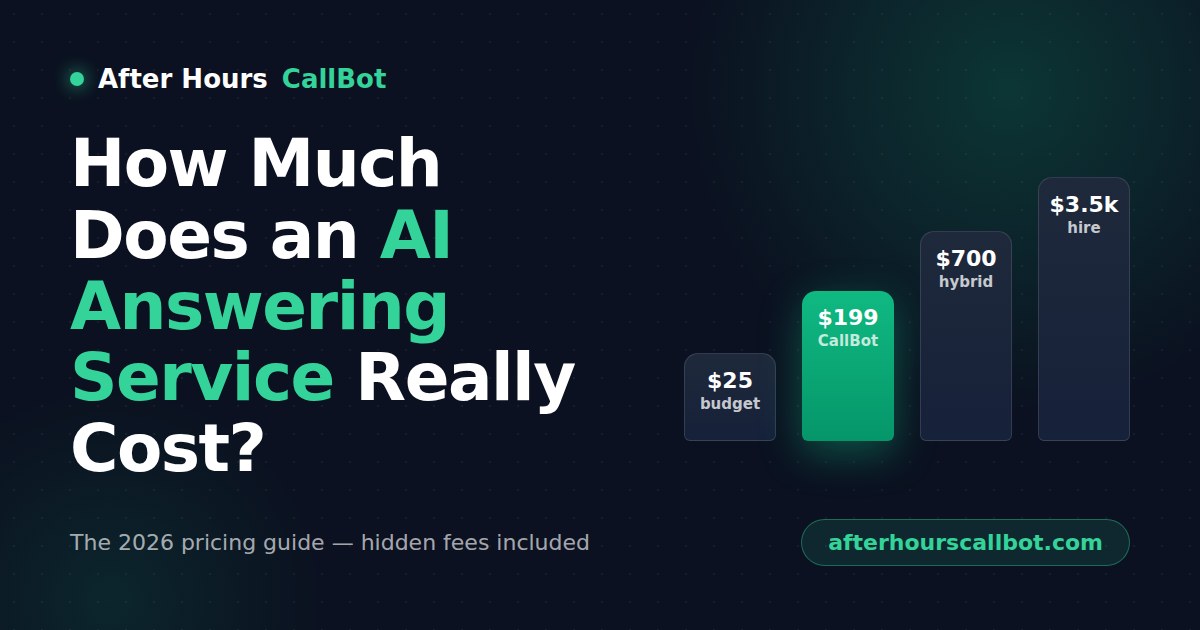
AI answering services in 2026 cost anywhere from $25 to $900 per month — a range so wide it's almost useless. The real answer depends on three things: how your provider bills (flat-rate, per-minute, or per-call), whether humans are in the loop, and how much of the work — booking, qualifying, texting you summaries — the AI actually finishes. Here is the complete pricing breakdown, including the fees most providers don't put on their pricing page.
The Three Pricing Models — and Why the Cheapest Sticker Rarely Wins
Every AI answering service on the market bills one of three ways, and the model matters more than the headline number.
Flat monthly rate with included minutes. You pay one predictable price for a bucket of call minutes. This is the model After Hours CallBot uses — $199/month for 150 minutes, $299 for 400, or $499 for 1,000, with overage at a flat $0.12 per minute. The advantage is budgeting certainty: a chaotic week of storm-damage calls or a holiday reservation rush doesn't produce a surprise invoice.
Per-call or per-conversation pricing. Common with hybrid AI-plus-human services. Rates typically run $6 to $12 per handled call. That sounds harmless until you do the math: a modest 60 calls a month lands between $360 and $720 — more than most flat-rate plans — and every marketing win that drives more calls drives your bill up with it.
Per-minute metered pricing. The traditional answering-service model, now worn by some AI providers too. Live services run $0.90 to $1.50 per minute; AI versions run $0.30 to $0.70. The trap is talk-time inflation: a friendly caller who chats for six minutes costs triple a two-minute call, and you control none of it.
What the Market Actually Charges in 2026
| Service type | Typical monthly cost | Billing model | Best fit |
|---|---|---|---|
| Budget AI receptionists | $25–$99 | Flat, low minute caps | Solo operators, light volume |
| Full-featured AI answering (After Hours CallBot) | $199–$499 | Flat with included minutes | Service businesses that book jobs by phone |
| Hybrid AI + human services | $95–$700+ | Per-call tiers | Businesses wanting occasional human escalation |
| Live human receptionists | $235–$1,500+ | Per-minute bundles | High-touch, low-volume practices |
| In-house receptionist | $3,000–$4,500 | Salary + taxes + benefits | Front-desk work beyond the phone |
Two things jump out of that table. First, even the most expensive AI tier costs roughly a tenth of a human hire — and the human works 40 hours a week, not 168. Second, the spread between budget AI and full-featured AI is not about call quality alone; it's about what happens after hello.
The Hidden Fees That Wreck the Comparison
Sticker prices are designed to be compared; invoices are not. When you evaluate any AI answering service, ask directly about these five line items:
Setup and onboarding fees. Some services charge $100 to $500 to configure your account and train the AI on your business. After Hours CallBot's setup is self-serve and free — paste your website, and the AI learns your services, hours, and FAQs in minutes.
Per-feature add-ons. Appointment booking, SMS follow-ups, CRM integration, and call recordings are frequently $20 to $75/month each on top of base pricing. A "$99 plan" that needs three add-ons is a $250 plan wearing a disguise.
Overage rates. This is where metered plans bite. Overage on some services runs $1.25 to $2.00 per minute — ten times the marginal cost. A flat overage like CallBot's $0.12/minute means a busy month costs a few extra dollars, not a few hundred.
Phone number and porting charges. Monthly number rental and one-time porting fees of $10 to $50 appear on many invoices. Most businesses never need to port at all — call forwarding from your existing line takes two minutes to set up and preserves the number your customers already know.
Contract lock-in. Annual contracts with early-termination fees are still common among legacy answering services. Month-to-month with a free trial is the modern standard; anything else shifts the risk onto you.
The Only Cost Number That Matters: Cost Per Captured Job
Comparing subscription prices misses the point of the purchase. The question is not "what does the service cost?" but "what does a captured call cost — and what is it worth?"
"Companies that respond to leads within an hour are 7x more likely to qualify them than those responding even one hour later."
Run the math for a plumbing company on the $299 Pro plan. If the AI answers 100 after-hours and overflow calls a month and converts just eight of them into booked jobs at a $450 average ticket, that is $3,600 in revenue against a $299 cost — a 12x return, before counting lifetime value or referrals. We walk through the sourced math in how much a missed call costs a small business — the short version is that a service business missing 30% of 40 weekly calls at a $350 ticket loses roughly $3,000 a month.
Reverse the lens and the pricing question answers itself: an answering service does not have to be cheap, it has to be cheaper than the calls you're currently losing. For nearly every service business, one saved job per month pays the entire subscription.
Cost Per Answered Call, Compared
| Option | Monthly cost | Coverage | Effective cost per after-hours call answered* |
|---|---|---|---|
| Voicemail | $0 | None — 80% of callers won't leave a message | Revenue lost, not saved |
| After Hours CallBot Pro | $299 | 24/7/365, books jobs, texts you summaries | ~$3 per call at 100 calls/mo |
| Hybrid AI + human | $400–$700 | 24/7 with human handoff | $6–$12 per call, billed per call |
| Live answering service | $350–$1,200 | Business hours + on-call surcharges | $4–$8 per short call, more if chatty |
| Hiring a night receptionist | $3,500+ | One shift, five days | $35+ per call at typical volume |
*Assumes ~100 answered calls/month at typical service-business talk times.
What You Should Get at Each Price Point
If you're paying under $100/month, expect scripted answers, a transcript by email, and little else — fine for a solo operator who mainly needs "what are your hours?" handled. From $199 to $499, the standard should be much higher: natural conversation trained on your business, live appointment booking, lead qualification, emergency triage, instant SMS summaries to your phone, and a dashboard with recordings and transcripts. That's the tier After Hours CallBot competes in — see the full pricing breakdown — and it's deliberately priced under the hybrid services whose human minutes you rarely need. Above $700, you're paying for human beings on headsets; worthwhile for a white-glove medical practice, hard to justify for a restaurant fielding reservation calls or a plumber triaging a burst pipe at 2 AM.
Flat-Rate Certainty
$199, $299, or $499 a month — your busiest month costs the same as your slowest, with overage at just $0.12/min.
No Setup Fees
Self-serve onboarding reads your website and builds your agent in minutes. $0 to start, no contract.
Everything Included
Booking, lead capture, SMS summaries, recordings, and transcripts are in every plan — not sold as add-ons.
Pays for Itself
One captured job per month typically covers the entire subscription. Everything after that is profit.
"An answering service doesn't need to be cheap. It needs to be cheaper than the calls you're losing — and for most service businesses, that math takes one saved job a month."
Prices are one half of the decision. The other half, how many extra booked jobs a month each plan needs to pay for itself in your trade, is in Is an AI Receptionist Worth It? The Break-Even Math.
See your own numbers
Fourteen days of real calls beats any pricing table.
Start a free trial, forward your after-hours calls, and count the booked jobs before you pay a dollar.
14-day trial · No credit card required · Cancel anytime
- How much does After Hours CallBot cost per month?
- Three flat plans: Starter at $199/month with 150 minutes, Pro at $299/month with 400 minutes, and Business at $499/month with 1,000 minutes. Overage is $0.12 per minute on every plan, and every plan starts with a free 14-day trial — no credit card required.
- Is an AI answering service cheaper than a human answering service?
- Substantially. Live services bill $0.90–$1.50 per minute, so 400 minutes of coverage runs $360–$600 versus a $299 flat AI plan — and the AI covers nights, weekends, and holidays at no premium, where human services typically add surcharges.
- What hidden fees should I watch for when comparing services?
- Setup fees ($100–$500), per-feature add-ons for booking or SMS ($20–$75/month each), punitive overage rates ($1.25+/minute), number porting charges, and annual contracts with early-termination fees. Ask for a sample invoice at your expected call volume, not just the pricing page.
- How many minutes do I actually need?
- Most service-business calls run 2–4 minutes. At 40–60 after-hours calls a month, 150 minutes fits; at 100–150 calls, choose 400. Your dashboard shows real usage during the trial, so you can pick a plan from data instead of guessing.
- Does using AI mean I lose the calls that need a real person?
- No. The AI books and qualifies routine calls, flags genuine emergencies for immediate attention, and texts you a summary of every conversation — so the calls that need you reach you, minus the ones that didn't.
New to the category? What is a callbot, and how does it work? covers the mechanics before the price.
Key takeaways
- AI answering services span $25–$900/month in 2026; the billing model (flat vs per-call vs per-minute) matters more than the sticker.
- Per-call and per-minute pricing punishes growth — flat-rate plans keep your busiest months predictable.
- Always price the invoice, not the plan: setup fees, add-ons, and overage rates routinely double budget offerings.
- The metric that decides the purchase is cost per captured job — one saved booking a month typically pays for the service.
- After Hours CallBot runs $199–$499 flat with booking, SMS summaries, and recordings included, and a 14-day free trial to verify the math with your own calls.