

What Is a Callbot? How AI Call Bots Work, What They Cost, and When a Small Business Needs One
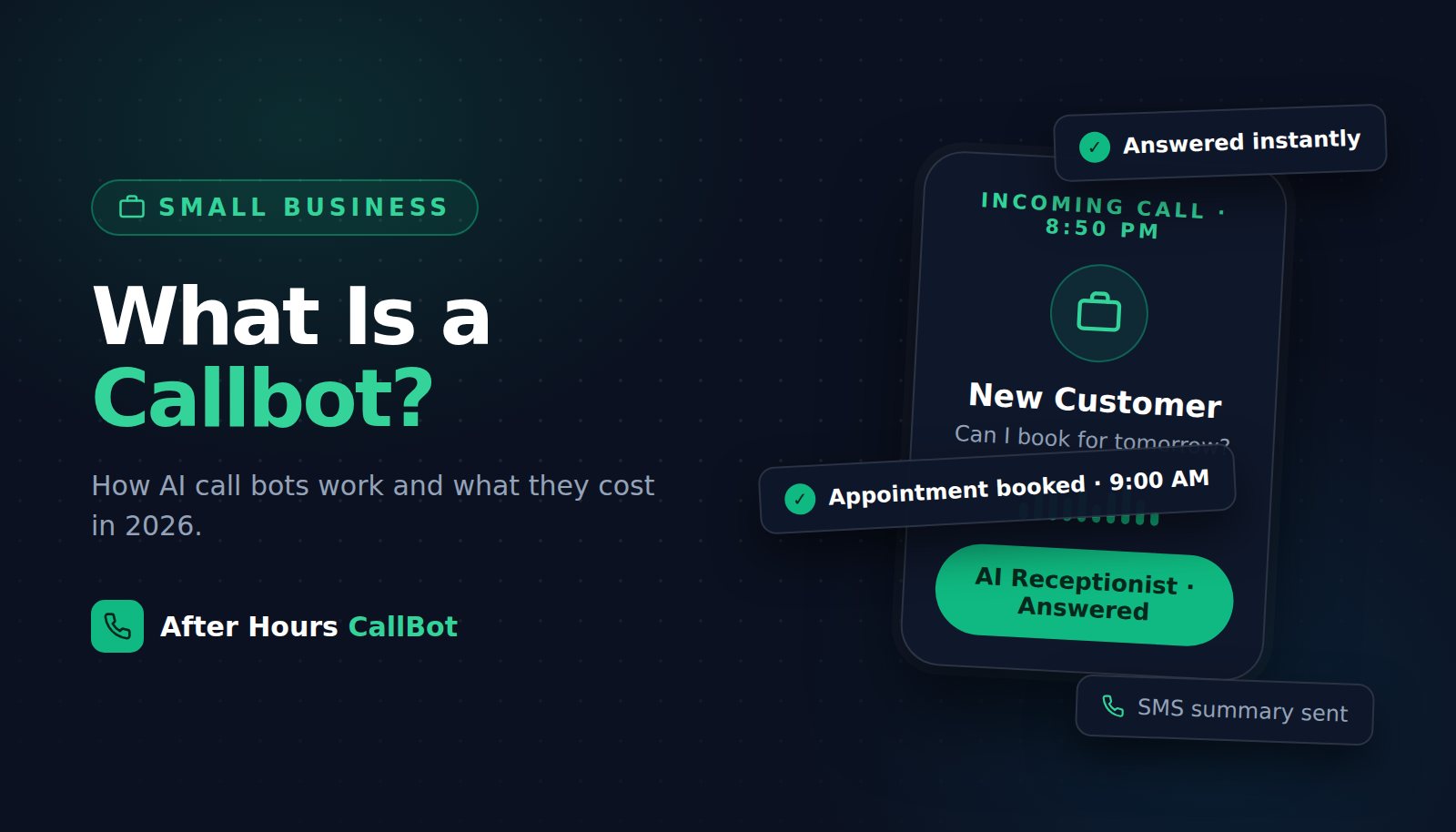
A callbot is software that answers a phone call and holds a conversation with the caller in a natural voice, without a person on the line. The modern kind listens to what the caller says, understands it, answers from what it has been taught about your business, and takes actions: books an appointment, takes an order, transfers an emergency, sends you a text. This post explains how a callbot works, what separates it from the phone trees you have hung up on, what one costs in 2026, and how to tell whether your business needs one.
Callbot, AI receptionist, voice agent: the same thing
The vocabulary is unsettled. "Callbot" is common in Europe and in the call-center industry. "AI receptionist" or "AI phone receptionist" is how US small businesses usually describe it. "Voice agent" and "conversational AI for phone" are the vendor terms. They all mean the same category: an automated system that takes inbound calls (and sometimes makes outbound ones) and converses rather than reading a menu. After Hours CallBot takes its name from the first word and does the job the second one describes.
What a callbot is not
- Not an IVR. The phone tree ("press 1 for sales") routes calls by keypad. A callbot has no menu; the caller just talks.
- Not voicemail with transcription. Voicemail records a message for later. A callbot resolves the call now.
- Not a chatbot. A chatbot types. A callbot speaks and listens, in real time, over a normal phone line, to someone who dialed a normal phone number.
- Not a call center. Searches for "bot call center" usually mean one of two things: a callbot replacing the call center for routine calls, or a call center using bots to deflect calls before an agent picks up. For a small business the first is the useful one.
How a callbot works, in one call
A customer dials your business number at 8:50 PM. Your phone system forwards the call to the callbot because nobody answered in four rings, or because it is after hours. What happens next, in under a second each:
- Speech recognition turns the caller's words into text as they speak.
- A language model reads that text together with everything it knows about your business, which came from your website and the notes you added at setup: hours, services, prices, service area, how you handle emergencies, what you never promise.
- It decides what to do: answer the question, ask a qualifying question, check your calendar, or follow a rule you set, such as "if the caller says gas smell, transfer to the on-call tech."
- Text-to-speech says the reply in a natural voice. The caller hears a short pause, then an answer, and keeps talking.
- Actions run during the call. It reads real availability from Google Calendar, Calendly or TidyCal and books the slot. It sends an SMS to your on-call person. It captures the caller's name and number.
- After the call, it texts and emails you a summary: who called, what they wanted, what was booked, what needs a human.
The whole exchange sounds like a competent receptionist who has read your website carefully and never puts anyone on hold. Hear one now: (321) 504-5467. Ask it anything a customer would ask you.
What a callbot can and cannot do
| Can do well | Should hand off |
|---|---|
| Answer the questions that make up most calls: hours, pricing, service area, do you take this insurance | Negotiate a price or a dispute |
| Book, reschedule and cancel appointments into a real calendar | Complex multi-party scheduling |
| Qualify a lead with the questions you set and capture contact details | Give professional advice (medical, legal, structural) |
| Triage by rules and transfer true emergencies to a person immediately | Make the emergency decision itself |
| Take unlimited calls at the same time, at 3 AM, on a holiday | Replace the relationship an owner has with a long-time client |
| Speak English and Spanish, other languages by request |
The hand-off column is the point, not the exception. A well-configured callbot knows when to stop and connect a person, and it is better at that than voicemail, which never connects anyone.
Why small businesses are adding callbots now
Because the caller's behaviour changed before the technology did. The most-cited figure on business voicemail, from CRM Magazine, is that 80% of callers sent to voicemail leave no message. (CRM Magazine) BrightLocal's 2026 survey of 1,227 US consumers found 75% choose a local business in under 30 minutes and 72% consider three or fewer. (BrightLocal) And when a business calls back later, Hiya's 2026 State of the Call report says 86% of calls from unknown numbers go unanswered. (Hiya) A phone that is answered on the first ring, every time, is now the difference between getting the customer and never knowing they called. We go deeper on the behaviour in Why Customers Don't Leave Voicemails Anymore.
What a callbot costs in 2026
Nextiva's 2026 answering-service pricing guide puts AI answering services at $50–$300 a month and live operator services at $100–$1,000 or more, with live per-minute rates of $0.75–$1.50 and add-on fees for scheduling and recording. (Nextiva) Within the AI range the price tracks how much of the job the bot finishes. The cheapest tier answers and takes a message. The useful tier books, qualifies, transfers and summarizes.
| Callbot pricing model | How it bills | Watch for |
|---|---|---|
| Per minute | Every minute of every call | Cheap at low volume, unpredictable in a busy month |
| Per call | A fee per answered call | Short calls cost the same as long ones; add-ons for booking |
| Flat monthly with included minutes | One price, overage beyond the allowance | The overage rate; whether booking and after-hours are included |
After Hours CallBot uses the third model: $199 a month for 150 minutes, $299 for 400, $499 for 1,000, overage a flat $0.12 a minute, booking, SMS summaries and 24/7 coverage included, no setup fee, month to month. The full breakdown of what is and is not in a callbot's price, including the hidden fees that wreck comparisons, is in How Much Does an AI Answering Service Cost?, and the break-even math by industry is in Is an AI Receptionist Worth It?
Run your own call volume and job value in the missed-call calculator →
Does your business need one?
A callbot pays for itself when three things are true: customers call you, a missed call has a real cost, and the calls arrive when you cannot answer. That describes most of the businesses we have written about: plumbers and HVAC companies with emergency calls at night, dental practices whose front desk is busiest at 8 AM, roofers and contractors who are on the job all day, restaurants at 7:15 on Friday, law firms whose potential clients call after work. If a missed call costs you a job worth more than one month of the plan, the arithmetic is settled.
How to set one up
Under ten minutes: paste your website so the bot learns your business, add the notes it could not get from the site, pick a voice, set the rules for transfers and emergencies, and forward your existing number on busy or no-answer. Your customers keep dialing the number they already have. Then call it yourself and ask the questions your customers ask.
See what a callbot would do with your calls. Run the numbers, then start a free 14-day trial, no card required, and read a week of call summaries.
Frequently asked questions
- What is a callbot?
- Software that answers phone calls and holds a natural spoken conversation with the caller, answering questions, booking appointments, qualifying leads and transferring emergencies, without a person on the line. In the US it is usually called an AI receptionist or AI phone answering service.
- How much does a callbot cost?
- AI answering services run roughly $50–$300 a month in 2026 depending on how much of the call they complete, against $100–$1,000 or more for live operator services. After Hours CallBot is $199, $299 or $499 a month with 150, 400 or 1,000 minutes included and $0.12 a minute beyond.
- What is the difference between a callbot and an IVR?
- An IVR is a keypad menu that routes calls. A callbot has no menu: the caller speaks naturally and the bot understands, answers and acts. Callers hang up on IVRs; they finish conversations with callbots.
- Can a callbot book appointments?
- Yes. It reads real availability from Google Calendar, Calendly or TidyCal and books, reschedules or cancels during the call, then confirms to the caller and texts you.
- Will callers know they are talking to a bot?
- It can introduce itself as an AI assistant, and many businesses prefer that. Either way, callers care that the phone was answered, the question was resolved and the appointment was booked. Most finish the call without asking.