
The First Cold Night Is the Worst Night of the Year for Your Phone
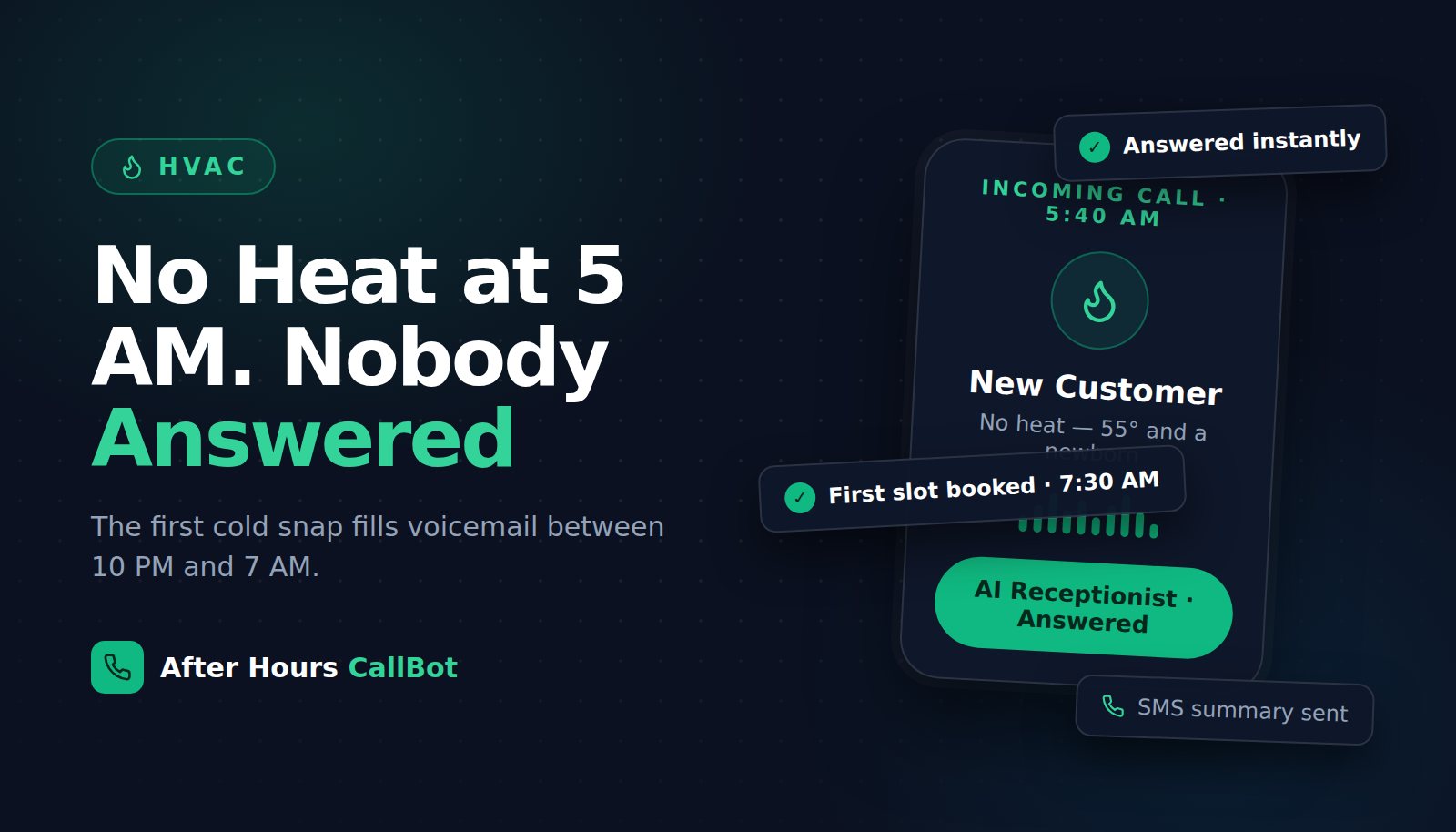
Every HVAC owner knows the July heat wave is coming and staffs for it. Fewer plan for the night in October when the temperature drops twenty degrees and every furnace that limped through last winter fails at once. The calls start at 10 PM, peak between 5 and 7 AM, and hit a dispatcher who is asleep, then a dispatcher who is on the other line. We covered why HVAC companies lose leads in peak cooling season. This is the other peak, and the phone behaves differently.
Why the first cold snap is worse than the first heat wave
- It is less predictable. Summer heat builds over days; the first hard frost arrives overnight, often mid-week, often before you've moved to winter staffing.
- The calls are more urgent. No AC is miserable. No heat, with a baby or an elderly parent in the house, is an emergency the homeowner will not wait on. They call until someone answers.
- The ticket is larger. A share of no-heat calls are not repairs. They are the 18-year-old furnace that is finally done, and the homeowner is about to buy a new one from whoever shows up first.
- It happens overnight. Heat failures announce themselves at bedtime and at 5 AM. The summer surge at least mostly happens in daylight.
KaiCalls' analysis of HVAC call handling, which we've cited before on this blog, describes the same pattern: miss rates for home-service contractors run roughly 20–30% of inbound volume in normal weeks and climb toward 40–50% during seasonal surges, with the first day of extreme weather producing the highest miss rate. (KaiCalls; vendor analysis, so treat the exact percentages as indicative.)
What the homeowner does at 5:40 AM with no heat
They do not leave a voicemail and wait for you to open. The most-cited figure on business voicemail, from a 2014 CRM Magazine analysis, is that 80% of callers sent to voicemail leave no message. (CRM Magazine) BrightLocal's 2026 survey of 1,227 US consumers found 75% choose a local business in under 30 minutes and 72% consider three or fewer. (BrightLocal) A homeowner in a 55-degree house at dawn calls three HVAC companies in a row and books the first one that picks up. When your dispatcher calls back at 8:05, Hiya's 2026 State of the Call report says 86% of calls from unknown numbers go unanswered — and by then the other company's truck is in the driveway. (Hiya)
The voicemail behaviour is covered in Why Customers Don't Leave Voicemails Anymore.
What a missed no-heat call is worth
| Outcome of the call | Typical value | Source |
|---|---|---|
| Emergency no-heat repair, after-hours | ≈ $1,000 (the figure we use across our HVAC material) | Internal assumption; substitute your own average ticket |
| Furnace replacement, installed | $4,814 national average; typical range $2,823–$6,896 | Angi, 2026 — 11,869 verified projects |
| Replacement with the ductwork and efficiency upgrades that usually come with it | ≈ $8,000 (the figure we use across our HVAC material) | Internal assumption |
Do the conservative version. On the first cold night, say twelve calls come in between 10 PM and 7 AM and eight ring out. Say six of those eight were real no-heat jobs, and one of the six was a replacement. At $1,000 for the repairs and $4,800 for the replacement, that is about $9,800 in one night that rang your number and was booked by someone else. A bad October has two or three of those nights.
Those inputs are assumptions, not measurements. Your own numbers give a better answer:
The callback trap, cold-snap edition
Harvard Business Review's audit of 2,241 US companies found only 37% responded to a lead within an hour and 23% never responded. (Harvard Business Review, 2011) HVAC companies are not slow on purpose. On the first cold night the on-call tech is on a roof with a flashlight and the dispatcher doesn't start until 7. The gap between 10 PM and 7 AM is where the replacement jobs go.
Why the on-call phone doesn't solve it
Most companies forward the office line to the on-call tech's cell after hours. On a normal night that works. On the first cold night it fails in a specific way: the tech is on a call, the second and third callers ring through to his voicemail, and he doesn't see the missed calls until he's back in the truck. Two of those three have already booked elsewhere. The tech was doing his job. The phone just needed to be answered by something that wasn't him.
Four ways to cover the first cold night, ranked by whether the caller hears a voice
| Option | Caller gets an answer now? | Works at 5 AM? | Works when three call at once? | Typical monthly cost |
|---|---|---|---|---|
| Forward to on-call tech | If he's not on another call | Yes, one at a time | No | $0 plus a tech answering on a roof |
| Overnight dispatcher | Yes, one at a time | Yes | No | A salary for a seat that's quiet 300 nights a year |
| Live answering service | Usually | Yes | Yes, at per-minute rates that spike with the surge | Per-minute or per-call, after-hours premiums |
| AI phone receptionist | Yes, every call, first ring | Yes | Yes, unlimited simultaneous calls at a flat rate | Flat rate. After Hours CallBot: $199–$499/mo |
What an AI receptionist does on a no-heat call
It answers on the first ring at 5:40 AM, trained on your company: your service area, the brands you service, your after-hours rates, how you triage. On a call it can:
- Triage the emergency by the questions you set — any heat at all, smell of gas, age of the system, anyone vulnerable in the home — and tell the caller exactly what happens next.
- Book the first available slot into real calendar availability (Google Calendar, Calendly and TidyCal on every plan), so the caller hangs up with a time, not a promise.
- Escalate the true emergencies. A keyword you choose — "gas smell," "carbon monoxide alarm," "no heat, newborn" — triggers an immediate warm transfer to the on-call tech or an SMS alert.
- Take every call at once. The eighth caller at 6 AM gets the same first-ring answer as the first, which is the whole point on a surge night.
- Text the dispatcher a summary after every call, so 7 AM starts with a routed board instead of a voicemail box.
Setup is under ten minutes: paste your website, pick a voice, forward your existing number so customers keep dialing the one on the truck. It answers in English and Spanish; other languages by request.
Hear it take a call now: (321) 504-5467.
The arithmetic
Plans run $199, $299 and $499 a month, each with included call time and $0.12 a minute beyond it, with a 14-day free trial and no card required.
Against one $4,800 furnace replacement, the Starter plan pays for itself for two years the first time it books one 5 AM call that would have gone to the on-call tech's voicemail. The HVAC-specific setup, including seasonal call flows and emergency triage, is on the HVAC answering service page.
Find out what the first cold night will cost. Run the numbers, then start a free 14-day trial now, before it arrives, and forward the line. Count the replacements that book while the on-call tech is on a roof.
Frequently asked questions
- When do HVAC companies miss the most heating-season calls?
- Overnight and early morning on the first hard cold snap of the fall, when every marginal furnace fails at once and calls stack up between roughly 10 PM and 7 AM, before the dispatcher is in.
- Will a homeowner with no heat leave a voicemail?
- Usually not. The widely cited figure is that 80% of callers sent to business voicemail leave no message, and most consumers choose a local business within 30 minutes. A cold house at dawn calls the next company on the list.
- What does a furnace replacement cost in 2026?
- Angi's data from 11,869 verified projects puts the national average at $4,814 installed, with most projects between $2,823 and $6,896. A missed call on the first cold night can easily be one of these.
- Doesn't forwarding to the on-call tech cover nights?
- Only one call at a time. On a surge night the tech is on a job and the second and third callers hit his voicemail. An AI receptionist answers unlimited simultaneous calls and only escalates the ones you define as emergencies.
- Can an AI receptionist handle gas-smell or carbon-monoxide calls safely?
- You set the keywords and the response. A gas-smell or CO-alarm call can be told to leave the house and call the utility or 911, then warm-transferred to your on-call tech immediately.