
Why HVAC Companies Lose Their Best Leads in Peak Season (and How to Stop the Leak)
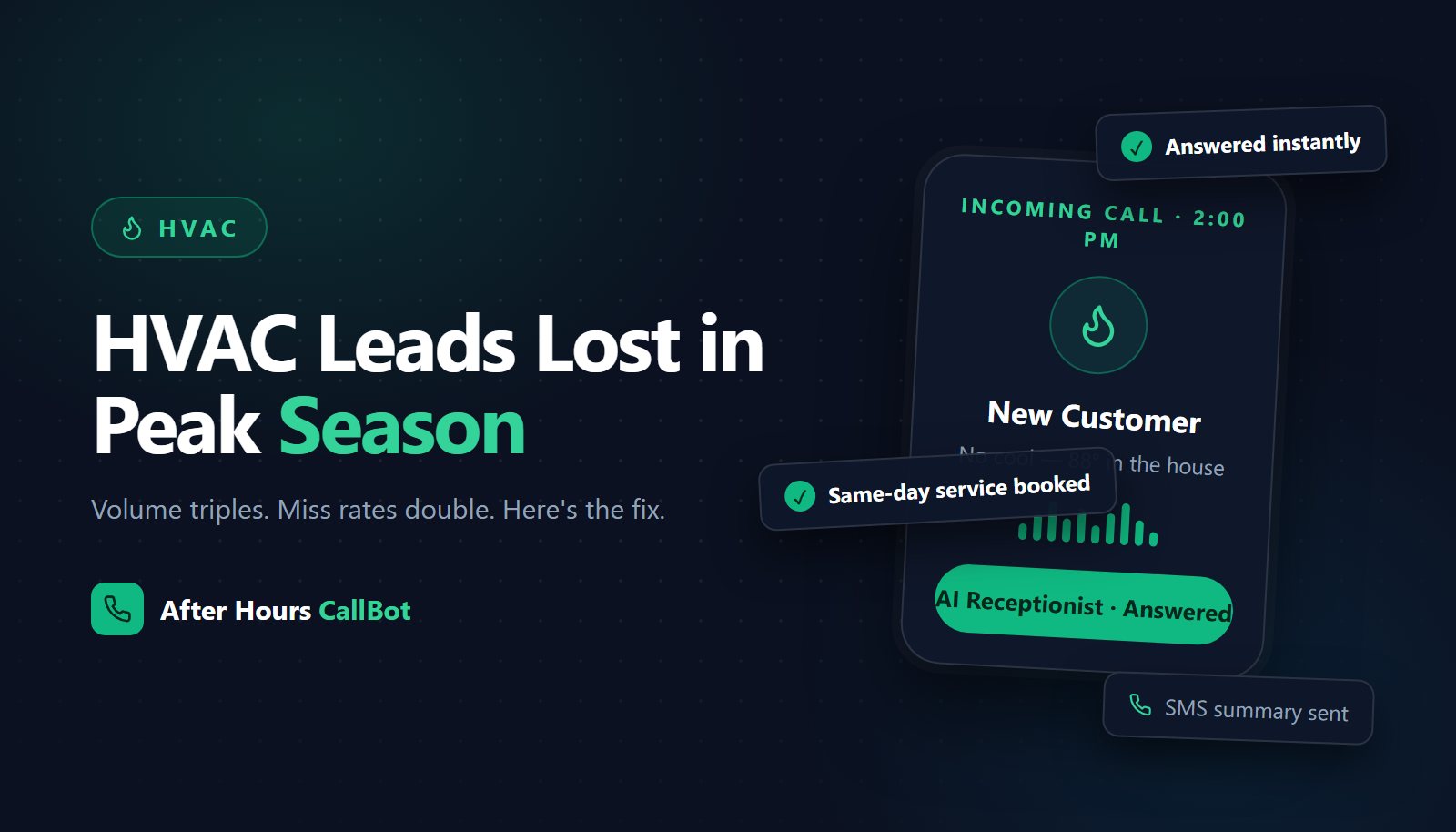
The first real heat wave of the summer is the best week of the year for an HVAC company's phone and the worst week for its answer rate. Those two facts are the same fact. The calls arrive because every unit in the county is failing at once, and they go unanswered because every technician in the company is standing in front of one of those units.
This is not a staffing problem you can hire your way out of. It is a structural one, and it has a structural fix.
The peak-season paradox, in numbers
The most specific published data on HVAC call handling comes from KaiCalls, an answering vendor reporting on its own call volumes, alongside ServiceTitan's 2024 benchmarks as it cites them. (KaiCalls) Vendor data, so treat the exact figures as indicative; the shape is what matters.
| Measure | Figure |
|---|---|
| Summer call volume vs baseline | 200–400% above baseline |
| Winter call volume vs baseline | 150–300% above baseline |
| Miss rate, shoulder seasons | 10–20% |
| Miss rate, first heat wave | 30–50% |
| Miss rate, cold snaps | 25–40% |
| Answered calls that convert to booked jobs (ServiceTitan 2024, as cited) | 65–75% |
| Repair revenue per call (ServiceTitan 2024, as cited) | $450–$1,200 |
| Replacement revenue per call (ServiceTitan 2024, as cited) | $5,000–$12,000 |
| Paid lead cost (ServiceTitan 2024, as cited) | $50–$200 |
Independent consumer pricing data agrees on the ticket: Fixr puts the average AC repair at $375, typical range $250–$700, with emergency calls billed at 2–3 times the normal hourly rate. (Fixr, 2026)
Put the rows together. Volume triples. The miss rate doubles or worse. And the calls being missed convert at 65–75% when answered, into tickets that run from a few hundred dollars to a five-figure replacement. Peak season is when you miss the most calls, and the calls you miss are worth the most.
A July afternoon, from the dispatcher's chair
7:30 AM. Six techs roll out with full boards. The office opens at 8. Two "no cool" calls have already come in overnight and sit in voicemail.
9:40 AM. Three lines light up in the same minute. The CSR takes one. The other two hear ringing, then the greeting. One of them is a homeowner with a 2-year-old system under warranty; the other is a landlord with four units.
11:15 AM. A tech calls in about a part. While the CSR is on with the supply house, two more calls ring out.
12:30 PM. Lunch. The CSR eats at her desk and still misses four in forty minutes, because two arrived at once, twice.
2:00 PM. The heat peaks. So does the call volume. The CSR is now booking tomorrow, and tomorrow is full, so she is booking Thursday. Callers who hear "Thursday" hang up and call the next company; callers who hear ringing hang up faster.
5:15 PM. Office closes. The phones do not. The evening "no cool" calls, the ones from people who got home to an 88-degree house, go to voicemail until 8 AM.
Nobody in that day was lazy. The CSR answered more calls than any human reasonably can. The company still missed a third of them, because one person can answer one call at a time and the calls did not arrive one at a time.
Where the missed calls go
They don't wait, and they don't leave a message.
- KaiCalls' own data: 80% of callers will not leave a voicemail, and callers decide within about 11 seconds of ringing. The widely cited business-wide figure, attributed to Forbes, is the same 80%. (CRM Magazine)
- BrightLocal's 2026 survey of 1,227 US consumers: 75% choose a local business within 30 minutes, and 72% consider three or fewer businesses. (BrightLocal) A homeowner sitting in an 88-degree house is at the fast end of that distribution.
- When you call back, you are an unknown number, and Hiya's 2026 data shows 86% of unknown calls go unanswered. (Hiya)
So the "no cool" call you missed at 9:40 was booked with a competitor by 10:10, and your 4:30 callback rang through to their voicemail. We go through the voicemail behaviour in detail in Why Customers Don't Leave Voicemails Anymore.
The callback trap, quantified
HVAC owners believe they call back fast. The Harvard Business Review audit of 2,241 companies found only 37% responded to a lead within an hour, 23% never responded, and the average response was 42 hours. (HBR, 2011) HVAC companies are not slower than average. In July they are structurally unable to be fast, because the person who could quote the job is on a roof or in a crawlspace when the call comes in. And if the lead came from Local Services Ads, Google's own documentation says "missed calls may negatively affect your responsiveness," a ranking input, so the next week's ad spend buys fewer calls too. (Google) That double cost is worked through in You're Paying for Calls Nobody Answers.
Why adding a CSR doesn't fix it
The obvious response is to hire a second CSR for the summer. It helps, and it fails at the same place the first one did.
A second person doubles the number of calls you can answer at once, from one to two. The 9:40 minute had three. The 12:30 lunch still has a gap. The evening still goes to voicemail. And the seasonal hire costs a full wage for the exact months your margins are best, then has nothing to do in October.
The problem is concurrency and hours, not effort. The fix has to answer an unbounded number of calls at the same time, at 9:40 and at 9:40 PM, and cost the same in July as in October.
The options, ranked by whether they survive the first heat wave
| Option | Answers every call in the 9:40 minute? | Evenings? | Cost in July vs October |
|---|---|---|---|
| Owner's or lead tech's cell | No, he's on a call or on a job | Yes, at his expense | Free, until it isn't |
| Second seasonal CSR | Two at once, not three | No | Full wage in July, nothing to do in October |
| Live answering service | Yes, if they pick up in time | Yes, usually at a premium | Per minute or per call: cost triples with the volume |
| AI phone receptionist | Yes, unlimited simultaneous calls | Yes | Flat rate. After Hours CallBot: $199–$499/mo |
Only the last two answer the third call in the 9:40 minute. Only one of them costs the same in the heat wave as in the shoulder season.
What an AI receptionist does on an HVAC call
After Hours CallBot answers on the first ring, every call, including the second and third simultaneous ones. It is trained on your company: service area, equipment you service, membership plans, diagnostic fee, how you triage. On a "no cool" call it can:
- Triage. Keywords you set ("no cool," "gas smell," "water leaking from the unit") trigger an immediate warm transfer to the on-call tech or an SMS alert to your phone. Everything else gets booked.
- Book into the real schedule. Google Calendar, Calendly and TidyCal on every plan; it checks live availability and books during the call, so the caller hangs up with a slot, not a promise.
- Capture what the tech needs. Address, system age and brand, what the homeowner is seeing, whether it's a membership customer.
- Hold the whole surge. Unlimited concurrent calls, so 2 PM in July looks like 2 PM in October from the phone's point of view.
- Tell you what happened. Email summary with name, reason and outcome after every call, and full transcripts in the dashboard.
Setup is under ten minutes; you forward your existing number so customers keep dialing the one on the truck. It answers in English and Spanish; other languages are by request. The HVAC-specific setup, including seasonal call flows, is on the HVAC answering service page. Hear it handle a call now: (321) 504-5467.
The arithmetic
Plans run $199, $299 and $499 a month with included call time and $0.12 a minute beyond it, with a 14-day free trial and no card required.
Against a $375 average repair, one recovered call a month covers Starter. Against a $5,000 replacement, one recovered call covers the year. In a heat wave where you are missing 30–50% of calls that convert at 65–75%, the question is not whether it pays for itself in July. It is how many Julys you have already paid for it without having it. The break-even math, including when it isn't worth it, is here. Your own numbers go in the missed-call calculator.
Frequently asked questions
- How many calls do HVAC companies miss in peak season?
- Vendor call data puts it at 30% or more in summer and winter peaks, rising to 30–50% during the first heat wave, against 10–20% in shoulder seasons.
- How much does HVAC call volume increase in summer?
- Reported at 200–400% above baseline in summer and 150–300% in winter, which is why miss rates climb: volume triples while the number of people who can answer stays the same.
- What is a missed HVAC call worth?
- Answered HVAC calls convert to booked jobs at a reported 65–75%. An average AC repair is $375 ($250–$700), with emergency calls at 2–3× the hourly rate, and replacements run $5,000–$12,000.
- Will hiring a second CSR fix missed calls in summer?
- Partly. It raises the number of simultaneous calls you can answer from one to two, but not three, and it does nothing for evenings or lunch. The problem is concurrency and hours, not effort.
- Can an AI receptionist handle HVAC emergency calls?
- Yes. It answers on the first ring, books routine calls into your calendar, and transfers true emergencies to the on-call tech on keywords you set, while answering an unlimited number of calls at once.