

Restaurant Answering Service: Five Ways to Cover the Phone During the Rush and After Close
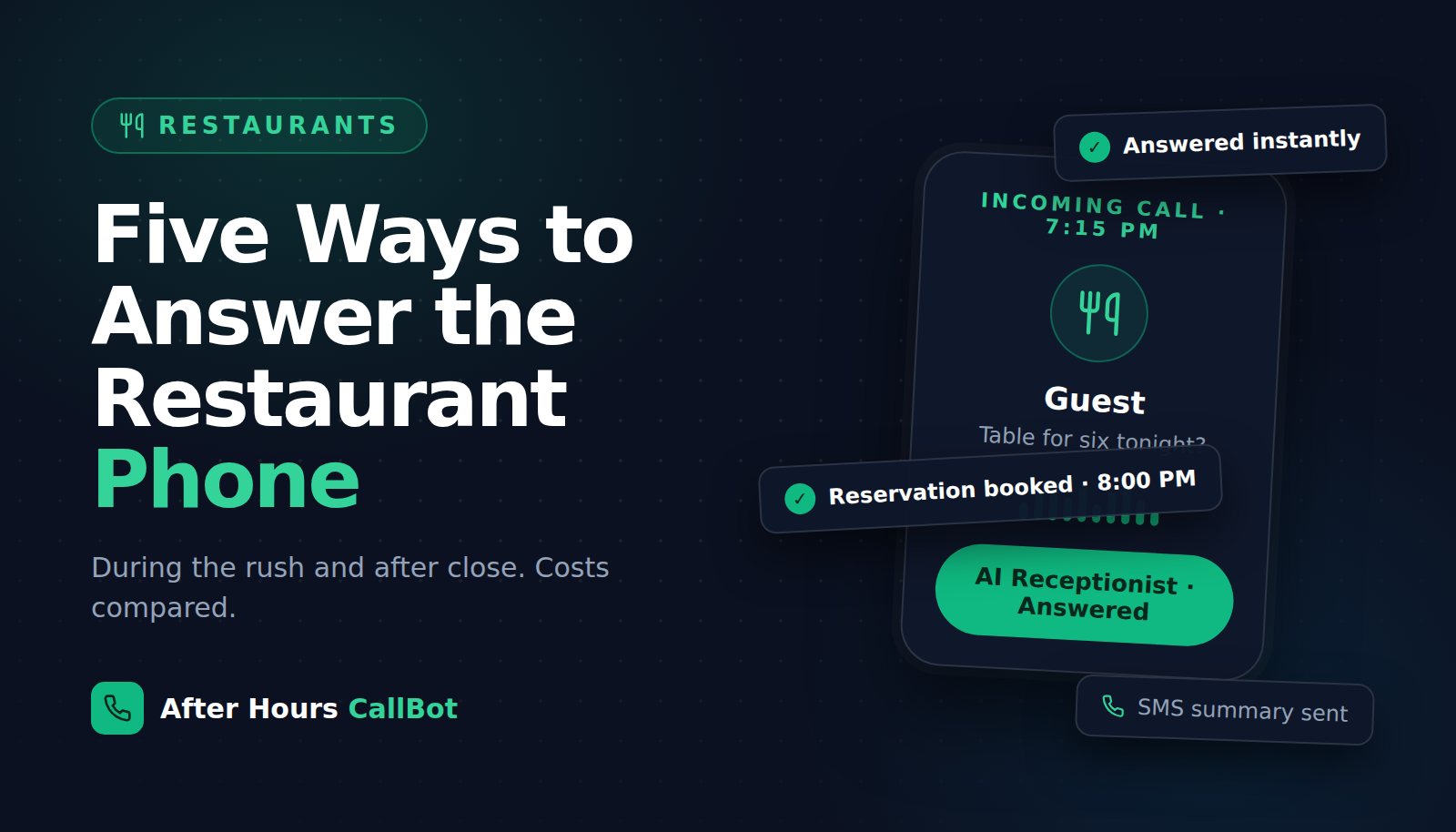
A restaurant answering service is a strange purchase, because the restaurant's phone problem is not that nobody is there. It is that everyone is there, and they are all carrying plates. The host picks up between seatings, the manager picks up from the pass, and the phone rings hardest at 7:15 on Friday when neither can. Then it rings again at 10:40 PM when the kitchen is closed and someone wants to book the private room for next Thursday. This post compares the five ways to cover that phone, what each costs, and which calls each one actually converts into covers.
How much of the ringing nobody answers
QSR Magazine, citing vendor call data, put the cost of unanswered restaurant phones at $20 billion a year, about $28,700 per restaurant, with 43% of restaurant calls unanswered overall, climbing toward 60% during peak service. (QSR Magazine; vendor data, so treat the exact figures as indicative.) The calls that ring out are not random. They are the reservation for tomorrow, the takeout order, the "can you seat eight tonight," and the catering inquiry, each of which we walked through in The Table Went to Whoever Answered. The caller does not leave a message: the most-cited figure is that 80% of callers sent to voicemail hang up without one. (CRM Magazine) BrightLocal's 2026 survey found 75% of consumers choose a local business in under 30 minutes. (BrightLocal) They booked somewhere else before the host finished seating the eight-top.
The five ways to cover a restaurant phone
1. The host stand, between seatings
Free, and it is what most restaurants do. It fails exactly when the restaurant is busiest, which is when the phone is busiest. Peak-hour calls go to hold or voicemail, and the 10:40 PM catering call goes to nobody.
2. Online reservations only, phone to voicemail
Reservation platforms handle the diners who prefer to book online. They do not handle the ones who call, and callers call for the things platforms don't do well: large parties, dietary questions, "are you open on the holiday," catering, "I'm running ten minutes late." Sending those to voicemail loses the covers and the goodwill.
3. Live operator answering service
Human operators answer in your restaurant's name and take messages or, with an add-on, book into a shared system. Nextiva's 2026 pricing guide puts per-minute rates at $0.75–$1.50, per-call pricing at $1–$11, and mid-range plans at $200–$600 a month, with scheduling frequently a $20–$50 add-on. (Nextiva, Answering Service Cost 2026) Restaurant calls are short but many: at 300 calls a month averaging two minutes, 600 minutes, that is about $750 a month at $1.25 a minute. The structural weakness is menu depth. An operator reading a script can take a reservation; asking whether the risotto can be made without dairy is a transfer or a "someone will call you back."
4. A dedicated phone person
Some high-volume restaurants put one person on the phone during service. At roughly $2,000–$2,800 a month for a part-time hire in wages before taxes (an assumption; use your market), it covers service hours one call at a time and nothing after close, which is when the private-dining and catering calls come.
5. AI phone receptionist
Software answers in a natural voice, trained on your restaurant: hours, menu, allergens, parking, private-dining capacity, catering minimums. It takes reservations into your real availability, answers the recurring questions, takes catering and large-party details, and texts the manager a summary. After Hours CallBot is $199 a month for 150 minutes, $299 for 400, or $499 for 1,000, overage a flat $0.12 a minute, no setup fee, 24/7 at one rate, unlimited simultaneous calls. The 600-minute month above is $499 on the Business plan, with the four 7:15 PM callers all answered on the first ring.
Side by side
| Option | Caller hears a voice at 7:15 PM Friday? | Answers at 10:40 PM after close? | Takes four calls at once? | Answers menu and allergen questions? | Typical monthly cost |
|---|---|---|---|---|---|
| Host stand between seatings | Sometimes, on hold | No | No | Yes | $0 plus the missed covers |
| Online reservations, phone to voicemail | No | No | n/a | No | Platform fees |
| Live operator service | Usually, after a hold | Yes, often at a premium | Depends on operators assigned | Only what is in the script | ≈ $750 at 600 minutes |
| Dedicated phone person | Yes, one at a time | No | No | Yes | ≈ $2,000–$2,800 |
| AI phone receptionist | Yes, first ring | Yes, same rate | Yes, unlimited | Yes, trained on your menu | $199–$499 flat |
What the calls are worth
| The call | Typical value | Basis |
|---|---|---|
| Reservation, party of four | $120–$200 | Internal assumption at $30–$50 per cover; use your own check average |
| Takeout order | $40–$80 | Assumption |
| Private room, 20 guests | $1,500–$3,000 | Assumption at $75–$150 per head with a minimum |
| Catering inquiry | $500–$5,000 | Assumption; varies widely by event |
Conservatively, if a service answers one extra four-top a night that would have rung out and one private-dining booking a month, that is roughly $5,000–$8,000 a month in covers against a $299–$499 plan. Those are assumptions. Your own numbers are better:
Run your call volume and check average in the missed-call calculator →
What the AI receptionist does on a restaurant call
- Takes the reservation into real availability by party size and time, and reads back the confirmation.
- Answers the questions that fill a restaurant voicemail box: hours, holiday hours, parking, dress code, kids, dogs on the patio, gluten-free options, corkage.
- Captures the big ones. Private dining and catering calls get the details taken, name, date, headcount, budget, and an immediate text to the manager or events lead.
- Handles the running-late call and the "we're outside, where's the entrance" call without pulling the host off the stand.
- Takes every peak-hour call at once, so the four 7:15 callers all hear a voice.
- Texts the manager a summary after each call, so the morning starts with a list of bookings, not messages.
Setup takes under ten minutes: paste your website and menu, pick a voice, forward the line on busy and after close so guests keep calling the number on Google. English and Spanish, other languages by request. The restaurant-specific flows, including reservation handling and events capture, are on the restaurant answering service page.
Hear it take a call now: (321) 504-5467. Ask for a table for six.
How to choose
- If your leak is peak service, which it is for most full-service restaurants, rule out anything that answers one call at a time.
- If private dining or catering is a meaningful share of revenue, insist on a service that takes the full inquiry and alerts a person immediately, not a message that waits for the morning.
- If the phone questions are mostly about the menu, a scripted operator will frustrate callers. Test any service with your three most common questions.
- Price at your Friday volume, not your Tuesday volume.
The arithmetic
Plans run $199, $299 and $499 a month, each with included call time and $0.12 a minute beyond it, with a 14-day free trial and no card required. One private-room booking from a 10:40 PM call that would have gone to voicemail pays for the Business plan for the quarter.
Find out what your unanswered calls are worth. Run the numbers, then start a free 14-day trial, forward the line on busy and after close, and count the covers that book during the Friday rush.
Frequently asked questions
- What is a restaurant answering service?
- A service that answers a restaurant's phone when the staff cannot: a live operator service, a dedicated phone person, or an AI phone receptionist that takes reservations, answers menu and hours questions, captures catering and private-dining inquiries, and texts the manager a summary, 24/7.
- Which platforms handle overflow calls for restaurants?
- Live operator answering services and AI phone receptionists both take overflow when you forward the line on busy or no-answer. The difference at peak is capacity: a live service takes as many calls as operators it has assigned to you, an AI receptionist takes every call simultaneously at one flat rate.
- How much does a restaurant answering service cost?
- Live operator services bill about $0.75–$1.50 a minute, roughly $750 a month at 600 minutes, plus add-ons. After Hours CallBot is flat-rate at $199–$499 a month with 150–1,000 minutes, unlimited simultaneous calls and after-close coverage included.
- Can an AI phone bot take restaurant reservations?
- Yes. It books by party size and time into your real availability, reads back the confirmation, and texts the manager. Large parties and private dining can be routed to a person immediately by rules you set.
- Who answers the phone when a restaurant is closed?
- With voicemail, nobody, and most callers hang up without a message. A live service answers after close at a per-minute rate that often carries a premium. An AI receptionist answers after close at the same flat rate and books the reservation or takes the catering inquiry on the spot.