
The Table Went to Whoever Answered: Restaurant Calls During the Friday Rush
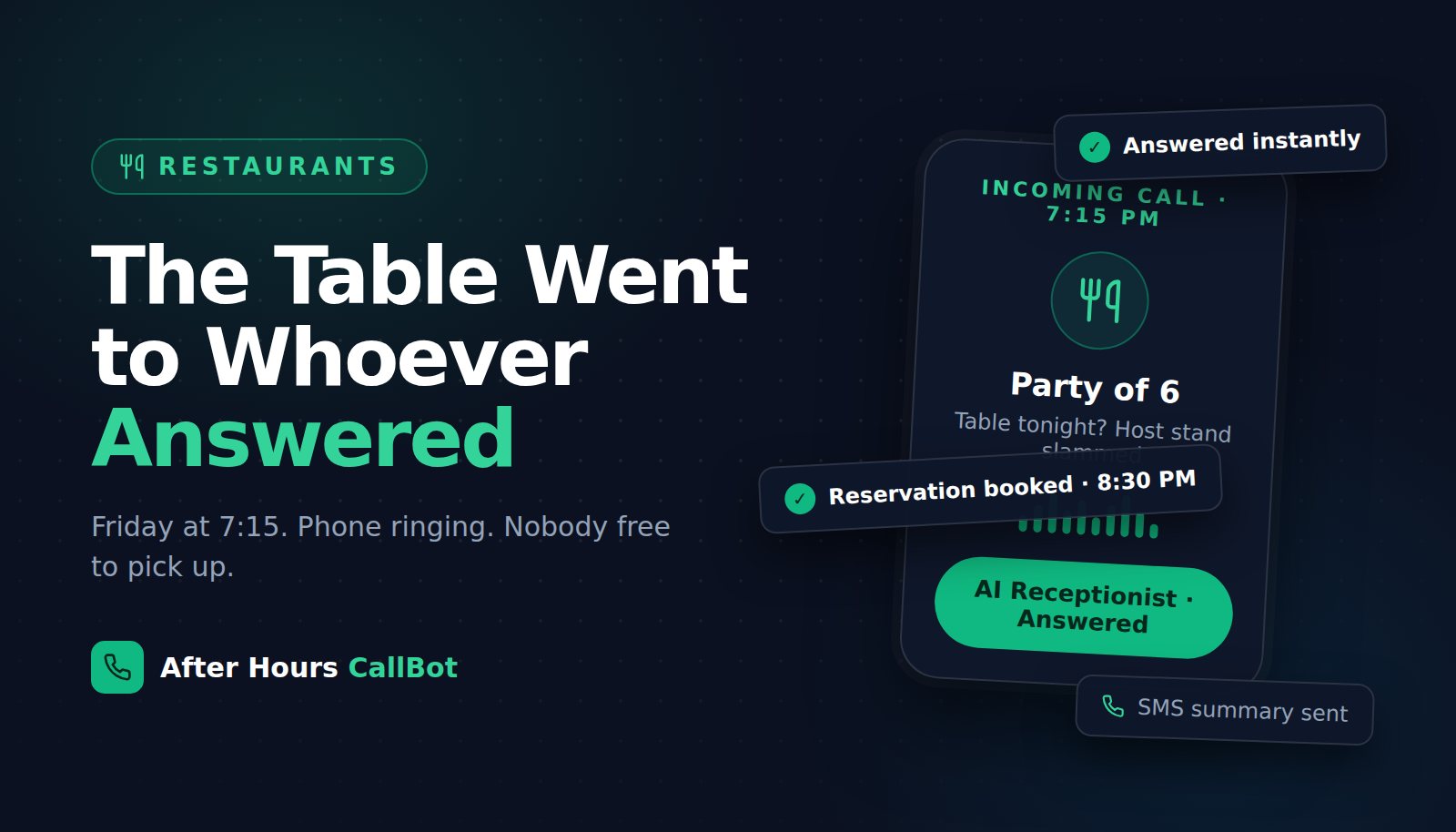
Every restaurant's phone rings hardest at exactly the moment nobody can pick it up. Friday at 7:15 the host stand has a line, both servers on the floor are triple-sat, and the phone is ringing under the reservation book. Whoever is calling wants a table for six tonight, a reservation for Saturday, a catering quote for an office party, or to ask if you can do a nut allergy. They will get one of two things: a voice, or a ring-out. What they do next depends entirely on which.
How much of the ringing nobody answers
Restaurants are the one local business where the phone is still both the front door and the back door: reservations, takeout, catering, private events and the "are you open on Monday?" call all come through it. And a large share of it goes unanswered.
- QSR Magazine's analysis put the industry's loss from unanswered calls at roughly $20 billion a year, or about $28,700 per restaurant, and reported vendor call data showing 43% of restaurant calls go unanswered overall, climbing toward 60% during peak service. (QSR Magazine; the percentages are vendor datasets, so treat them as indicative rather than audited.)
- The most-cited figure on business voicemail, from a 2014 CRM Magazine analysis: 80% of callers sent to voicemail leave no message. (CRM Magazine) Nobody leaves a voicemail asking for a table in forty minutes.
- BrightLocal's 2026 survey of 1,227 US consumers: 75% choose a local business in under 30 minutes, and 72% consider three or fewer. (BrightLocal) A party deciding where to eat tonight has a shortlist of three. The first one to answer gets the six-top.
The behaviour is covered in more depth in Why Customers Don't Leave Voicemails Anymore.
A Friday night, from the phone's point of view
4:50 PM. Pre-shift. The manager is doing the schedule. A call comes in about a private room for twenty next Thursday. Voicemail. This one is worth more than the rest of the night's phone calls combined.
6:30 PM. First turn. The host is seating. Two calls, one right after the other: a reservation for tomorrow, a takeout order. One is answered and put on hold for three minutes; the caller hangs up. The other rings out.
7:15 PM. Peak. Walk-ins stacked at the stand, the phone ringing continuously. Nobody so much as looks at it. Four calls in twenty minutes.
9:40 PM. A couple leaving another restaurant calls to ask if the kitchen is still open. Voicemail. They go home.
10:30 PM. The manager checks voicemail. Two messages. One is the private-room inquiry; she calls back Saturday afternoon and gets no answer, because Hiya's 2026 State of the Call report found 86% of calls from unknown numbers go unanswered. (Hiya) The other is a wrong number.
What those calls were worth
| Call | What it was | Value |
|---|---|---|
| 4:50 PM | Private room, 20 guests, next Thursday | $1,500–$3,000 event, plus bar |
| 6:30 PM | Reservation for tomorrow, party of 4 | ≈ $120 at the average we use |
| 6:30 PM | Takeout order | $40–$80 |
| 7:15 PM ×4 | Mix of reservations and "can you seat six tonight" | ≈ $480 |
| 9:40 PM | Late couple, two entrées and drinks | ≈ $90 |
The $120 figure is the average reservation value we use across our restaurant material; substitute your own check average and party size. On one composite Friday that is more than $2,000 in tables and events that rang and went unanswered, before the catering inquiry. Multiply by the weekends in a month.
Those inputs are assumptions, not measurements. Your own numbers give a better answer:
Run your restaurant's numbers in the missed-call calculator →
The no-show problem is a phone problem too
The Resos No-Show Index 2026, built from 3.77 million real reservation outcomes at 2,417 restaurants between August 2025 and July 2026, puts the average no-show rate at 2.33%, rising to 3.17% for busy venues doing 500–999 bookings a month. (Resos) Owners describe it as an epidemic. (Washington Times, September 2026)
A big share of no-shows are people who tried to cancel or move a booking and couldn't get through. The call to cancel comes in at 5:45 PM, during pre-shift, and rings out. The table sits empty at 7:30. Answering the cancellation call is worth as much as answering the booking call: it frees a table you can fill from the walk-in line.
Four ways to cover the phone, ranked by whether the caller hears a voice
| Option | Caller gets an answer now? | Works at 7:15 on Friday? | Takes the catering call properly? | Typical monthly cost |
|---|---|---|---|---|
| The host answers between seatings | Sometimes, on hold | No | No — "can I take your number" | $0 plus a slower stand |
| Online-only reservations, phone to voicemail | No | No | No | Booking platform fees; the phone callers are lost |
| Live answering service | Usually | Yes | Generic script | $0.90–$1.50 per minute; a busy month adds up fast |
| AI phone receptionist | Yes, every call, first ring | Yes, unlimited simultaneous calls | Yes — trained on your event menu | Flat rate. After Hours CallBot: $199–$499/mo |
What an AI receptionist does on a restaurant call
It answers on the first ring, trained on your restaurant: hours, menu, dietary accommodations, private-dining options, parking, dress code, the things people actually call to ask. On a call it can:
- Book, change and cancel reservations against real availability, so the 5:45 cancellation frees a table instead of becoming a no-show.
- Answer the FAQ calls — are you open, do you take walk-ins, can you do gluten-free, is there parking — without pulling anyone off the floor.
- Take the catering and private-event inquiry in full: date, headcount, budget, occasion, contact details, and book a call with the manager.
- Route the calls that need a human — a large party tonight, a complaint, a vendor — with a warm transfer or an SMS to the manager's phone.
- Answer every call at once. The fourth caller at 7:15 gets the same first-ring answer as the first.
- Text the manager a summary after each call, with a full transcript in the dashboard.
Setup is under ten minutes: paste your website and menu, pick a voice, forward your existing number. It answers in English and Spanish; other languages by request.
Hear it take a call now: (321) 504-5467.
The arithmetic
Plans run $199, $299 and $499 a month, each with included call time and $0.12 a minute beyond it, with a 14-day free trial and no card required.
Against $2,000 of tables on one Friday, the plan pays for itself the first weekend it answers the phone at 7:15. The restaurant-specific setup, including reservation handling, menu FAQ and POS integration, is on the restaurant answering service page.
Find out what your Friday nights are costing. Run the numbers, then start a free 14-day trial and forward the line for two weekends. Count the tables that book while the stand is slammed.
Related: five ways to cover the restaurant phone during the rush and after close, compared.
Frequently asked questions
- How many restaurant phone calls go unanswered?
- Industry reporting puts it around four in ten overall, and higher during peak service. Those figures come from call-handling vendors' datasets, so treat them as indicative, but the pattern — the phone rings hardest when nobody can answer — is consistent everywhere.
- Do customers leave a voicemail for a restaurant?
- Almost never for a same-night table. The widely cited figure is that 80% of callers sent to business voicemail leave no message, and most consumers pick a local business within 30 minutes of starting to look.
- What is the average restaurant no-show rate?
- The Resos No-Show Index 2026, from 3.77 million real reservations, puts it at 2.33% on average and 3.17% for busy venues. Part of that is guests who tried to cancel by phone and could not get through.
- Can an AI receptionist take reservations?
- Yes. It books, modifies and cancels against your real availability, answers menu and hours questions, and captures catering and private-event inquiries with headcount, date and budget.
- What happens when a caller needs a person?
- You define the triggers — a large party tonight, a complaint, a supplier — and the call is warm-transferred to the manager or sent as an SMS alert. Everything else is handled without pulling anyone off the floor.